Wilson was a fine President
What happens when you have no fans...
Summary: The essay argues that Woodrow Wilson's declining reputation in recent years stems more from political circumstances than objective assessment of his legacy. Though personally racist and responsible for problematic policies, Wilson's presidential record was substantially influential, including founding the Federal Reserve, driving progressive reforms, and establishing the conceptual framework for post-World War II international institutions. The author contends that Wilson lacks a lasting political constituency to defend him, unlike presidents like Lincoln or FDR, making him vulnerable to criticism from both left and right.
Increasingly it seems like Wilson is one of the most popular to hate Presidents.
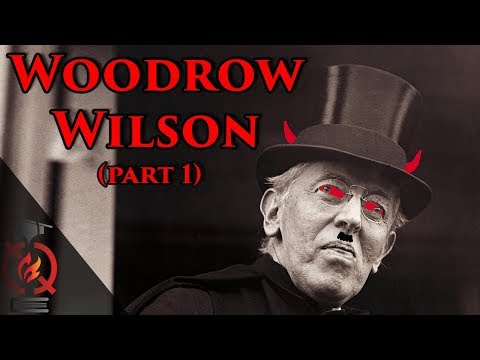
It has reached the point that he is becoming one of the most widely dispised politicians in American history.
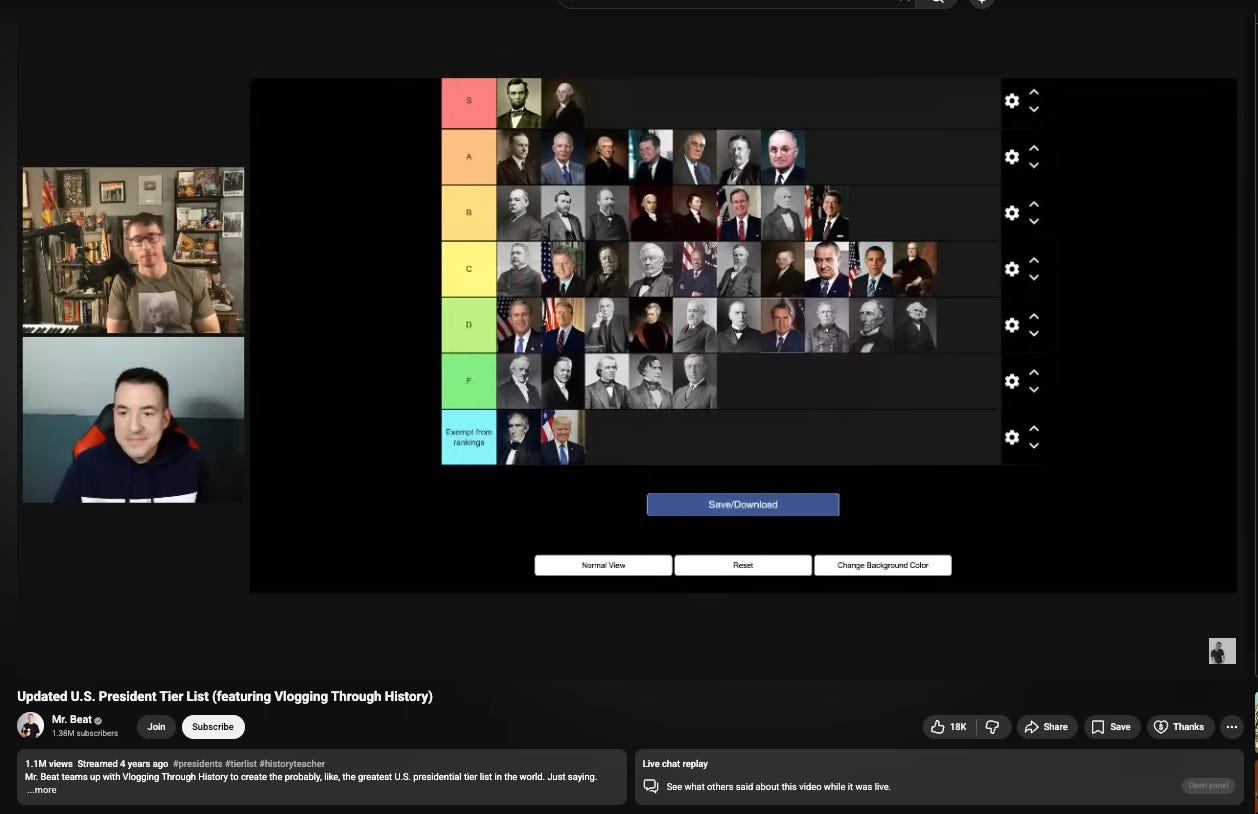
But I find this very annoying, and all a little insincere.
Woodrow Wilson was a fine president, and the rise of an anti-Wilsonian meme online has much more to do with a convergence of contradictory preferences than with any cool, objective reading of his legacy.
His actual record is straightforwardly influential. Wilson was the architect of the modern American regulatory state. He founded the Federal Reserve, the FTC, and oversaw the passage of the Clayton Antitrust Act. He helped establish the federal income tax as a working revenue system, supported the first federal child labor law, instituted the first federal eight-hour workday, and created the National Park Service(Thats right!!). He also backed the Federal Farm Loan Act and oversaw the ratification of both the 17th Amendment (popular election of senators), 18th (prohibition), and the 19th Amendment (female enfranchisement). He led the country in World War I and attempted—unsuccessfully—to create a stable international system based on national self-determination and collective defense. The entire 1945 international settlement—UN, IMF, World Bank, GATT, NATO—is Wilsonian in conception, and FDR is best understood in many ways as his successor.
“Through all of the centuries of recorded history and down to the world conflict of 1914 to 1918, wars were made by governments. Woodrow Wilson challenged that necessity. That challenge made the people who create and the people who change governments think. They wondered with Woodrow Wilson whether the people themselves could not some day prevent governments from making war.
It is but an extension of the challenge of Woodrow Wilson for us to propose in this newer generation that from now on war by governments shall be changed to peace by peoples.” - FDR
Until extremely recently, Wilson was seen as one of the greatest liberal presidents in American history, for reasons the above paragraph should make clear. In the original Schlesinger 1948 poll, he came in #4—only Lincoln, Washington, and FDR ranked higher. The 1962 Schlesinger poll also had him at #4. Siena had him in the top ten from 1982 onward, and C-SPAN’s first survey in 2000 ranked him #6, with the 2009 follow-up still placing him at #9. In other words, from 1948 through 2009, across essentially every major academic survey, he was a top-10 president, usually top six.
This changed during the “Great Awokening”. C-SPAN’s 2017 survey dropped him to #11, and Siena’s 2018 survey dropped him from #8 to #11. In June 2020, Princeton renamed its public policy school I’ll get more into his racism in a bit, but it should be clear that this alone has driven much of his fall. C-SPAN’s 2021 survey then placed him at #13 which is fully explained by a drop to the “Pursued Equal Justice for All” subscore.
The reason the consensus has collapsed is that Wilson has no permanent constituency in 2026. Most fine-to-great presidents have at least one group with a lasting interest in defending them. Lincoln both abolished slavery and was a Republican. FDR has the institutional Democratic Party under whose Principate we still reside. Even Coolidge and Harding have the libertarian right.
Wilson, on the other hand, is bashed by both the right and the left for entirely different reasons. From the right, he is seen as the driving force behind the federal regulatory state and as an architect of the surveillance state through the Espionage Act. His closest counterpart, Teddy Roosevelt, is also a Republican, which means attacking Wilson shifts certain achievements—such as the National Park Service—into Roosevelt’s column.
Meanwhile, the achievements that might otherwise appeal to the left are overshadowed by FDR, who can be seen as his direct political successor, and are not enough to overcome Wilson’s personal racism and his administration’s segregation of parts of the federal civil service. There is little incentive for modern leftists to defend Wilson over figures like LBJ or JFK, who come with less baggage.
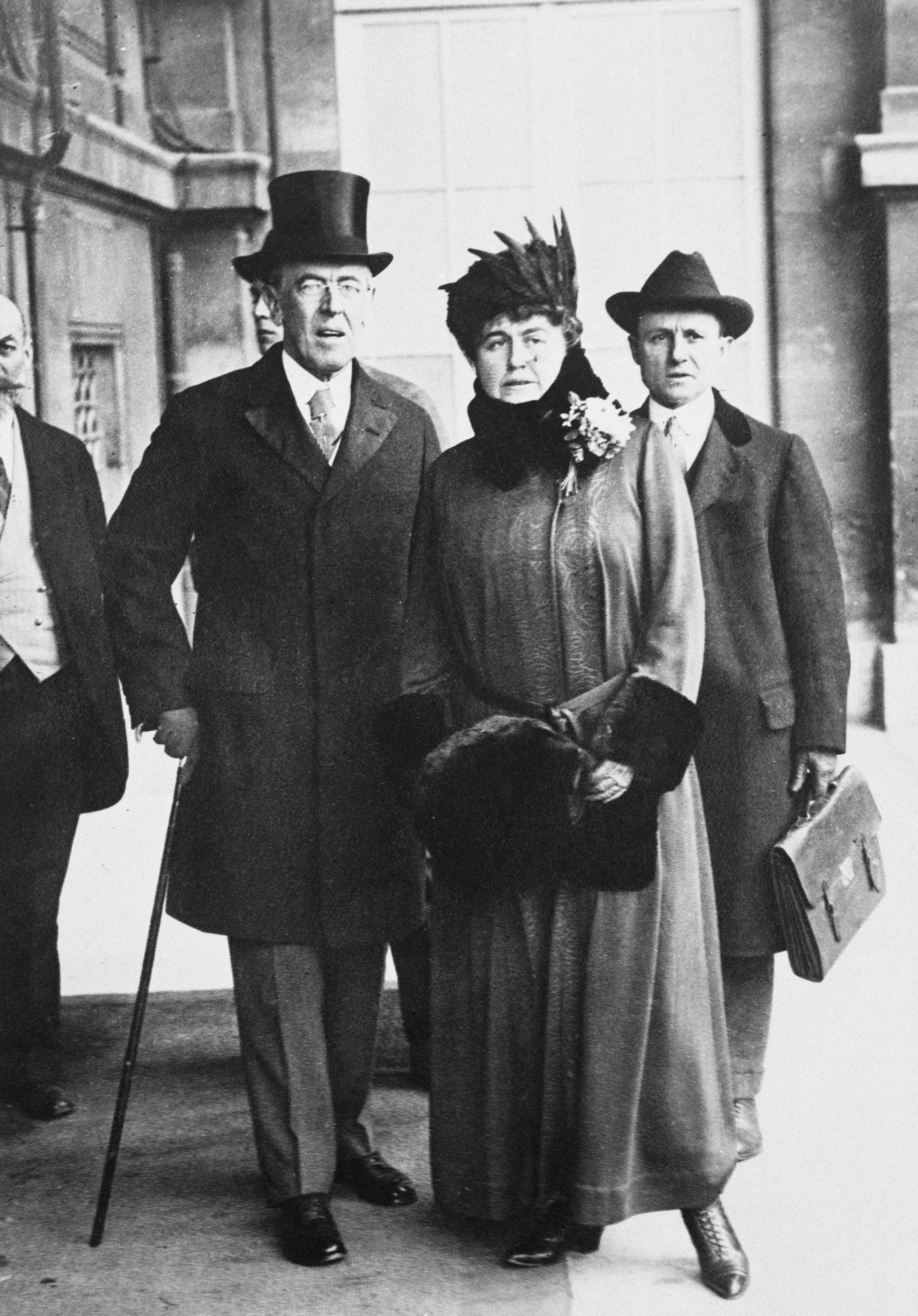
There is also a branding problem. Wilson was a somewhat austere WASP figure. He lacks dramatic anecdotes—like being shot and finishing a speech—and does not have the swagger associated with more culturally popular presidents. In photographs, he often looks like he is about to lecture you about phonics or chide you for using the wrong spoon.
Now, to the racism I mentioned earlier. It is unambiguous that Wilson was personally racist. He brought these views into office, most notably by screening Birth of a Nation at the White House in 1915 and allowing his cabinet officers to re-segregate their departments if they chose to.
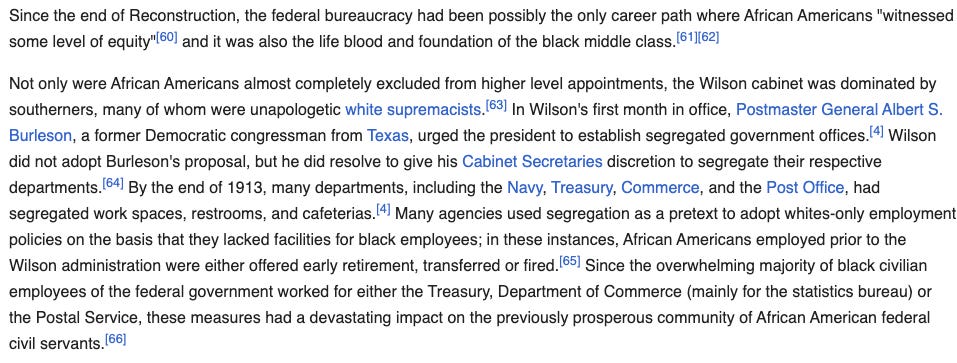
But the standard the American historical profession applied to presidents from 1948 to 2015 was relatively straightforward: what did this person do as president, weighed against the alternatives and judged within the political constraints of their time? By that standard, Jefferson is a top-five president despite being a slaveholder who fathered children with an enslaved woman. FDR ranks in the top three despite ordering the internment of 120,000 Japanese Americans. The standard is applied differently to Wilson, largely because there is no strong constituency willing to defend him.
Wilson was not my favorite President. His regulatory and surveillance policies likely created long-term distortions in the American economy. His personal racism was undeniable. And his delayed entry into World War I can plausibly be argued to have had catastrophic long-term consequences. But all of these factors were just as true in 2000 as they are today.
It is also worth saying plainly that some of what Wilson built has aged extraordinarily well. The Federal Reserve, for all its critics, ended the era of recurring bank panics that had defined American finance from 1873 through 1907. And on the 19th Amendment, Wilson’s September 1918 address to the Senate urging passage played an important role in getting it passed.
I don’t expect this to reverse the anti-Wilson sentiment, but it is frustrating to see an entire generation rank Teddy as their favorite president and Wilson as their least favorite, when in reality their policies were substantively quite similar.