Who was the best US president?
Results of the community poll from Washington to Lincoln
Summary: This essay presents a systematic ranking of US presidents through a tier-list voting system, scoring them from S (best) to F (worst). The author focuses on the early republic through Lincoln and argues that presidential quality generally declined over this period, with exceptions like Polk and Lincoln representing turning points. The ranking demonstrates that Washington, Lincoln, and Jefferson command the most consensus approval, while James Buchanan is judged as the weakest president in American history.
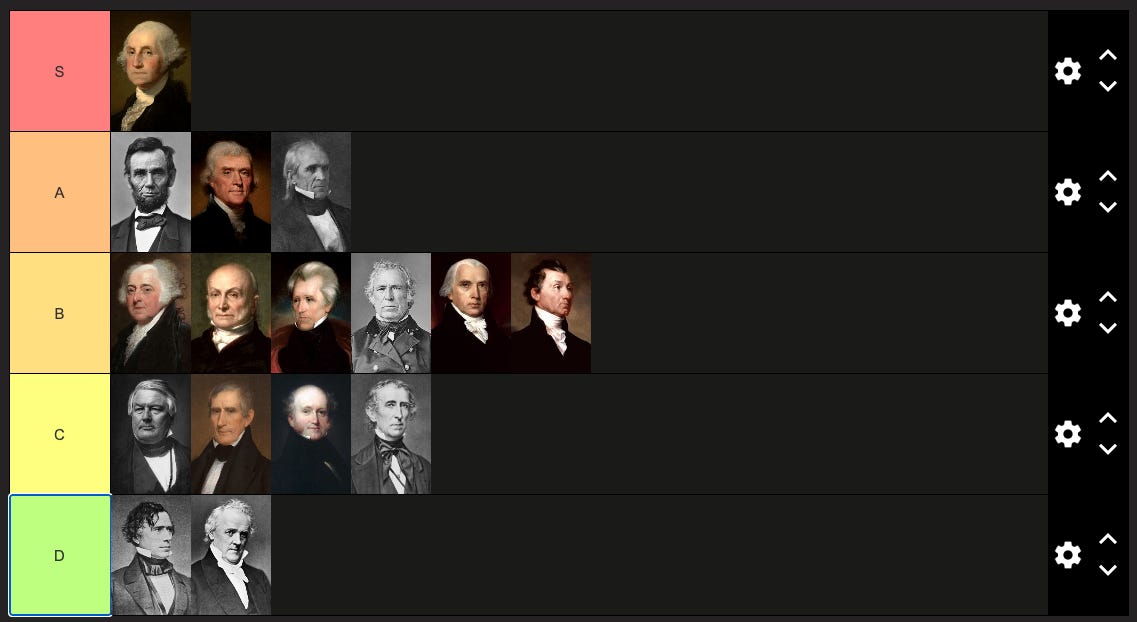
For a while now I’ve been running a daily presidential tier list over on Notes — with everyone voting on rankings of S through F. We’ve just reached Lincoln, which puts us about a third of the way through the line of presidents, and it feels like the right moment to step back and look at how the early republic graded out.
It’s also a natural breakpoint for a deeper reason. Lincoln is the last president elected under the first version of the American republic. Before the Civil War, the United States was less a nation than a confederation of Anglo settler colonies, aspirationally held together by a continental elite. The war reshaped all of it — and turned that loose arrangement into a genuine nation, bloodied and forged in the flame of war.
The republic that emerged lasted until roughly the FDR administration: an order dominated by liberal Yankee industrialists who believed in high tariffs, domestic development, and a strong federal government — strong, at least, by the standards of the time. So this is the first of three roundups. I’ll do another once we get through FDR and the second republic, and a final one when we reach the present, under the postwar presidencies.
How the scoring works
The format is simple. Each president gets rated S, A, B, C, or F. To turn letters into numbers, I mapped them onto a five-point scale: S = +2, A = +1, B = 0, C = −1, F = −2. Average that across every vote and each president gets a score. Here’s how they rank, with error bars showing plus or minus one standard deviation.
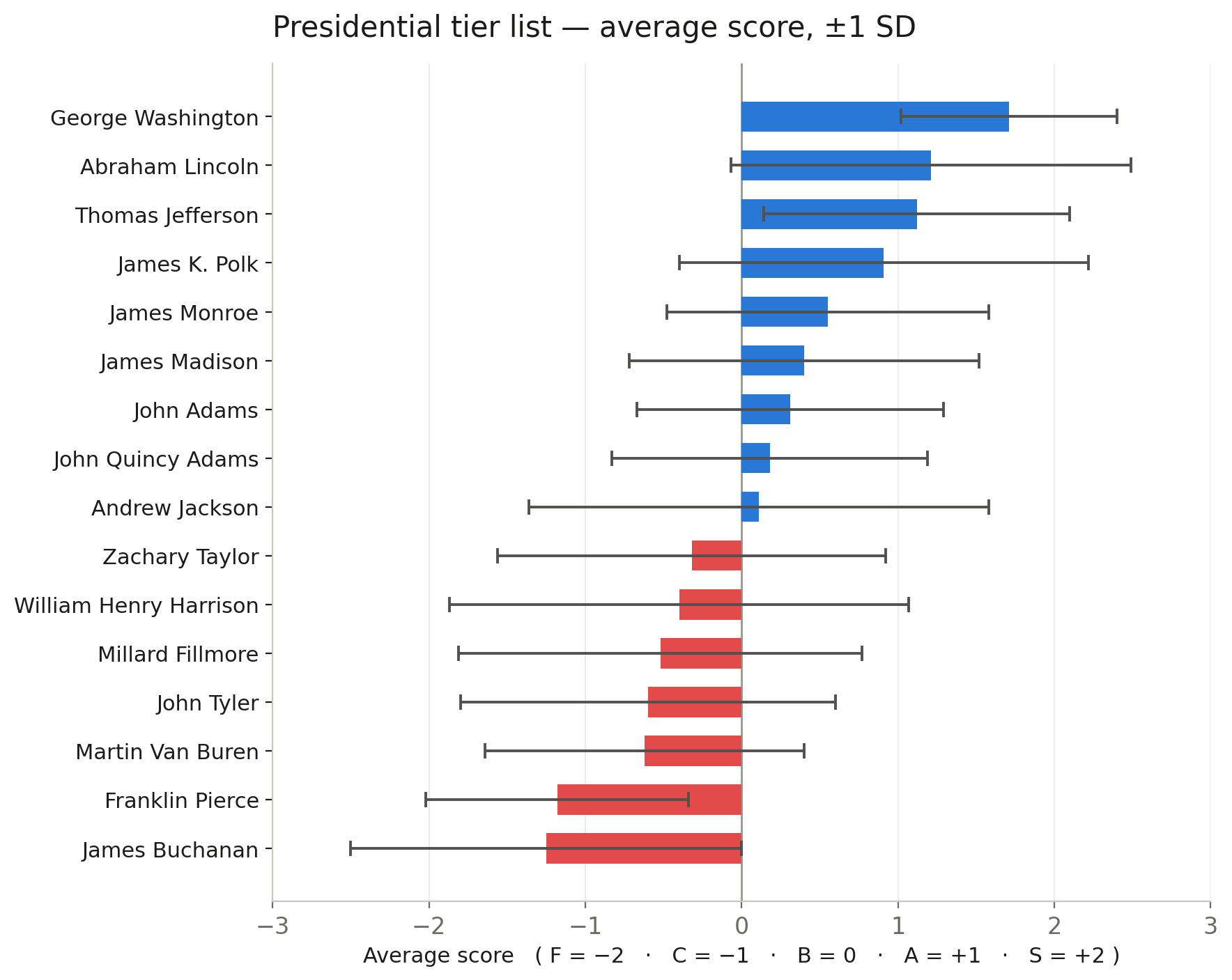
This looks about right to me. Washington, Lincoln, and Jefferson sit at the top. Jackson lands in the dead middle with enormous error bars. And Martin Van Buren, Franklin Pierce, and James Buchanan bring up the rear.
The long slide
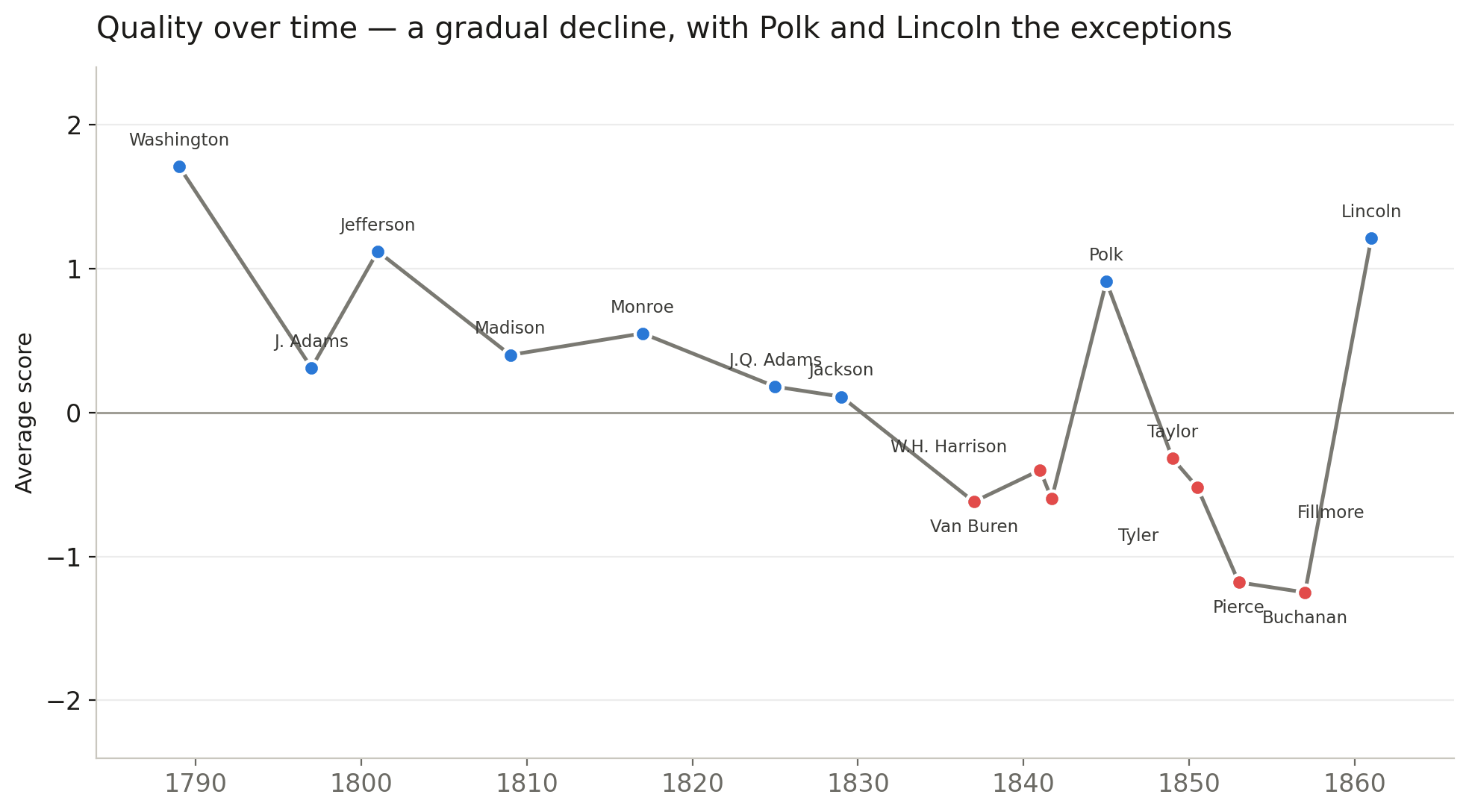
Plotted across time, the story is a gradual decline in quality, with Polk and Lincoln the only real exceptions to the slide.
Who do people actually care about?
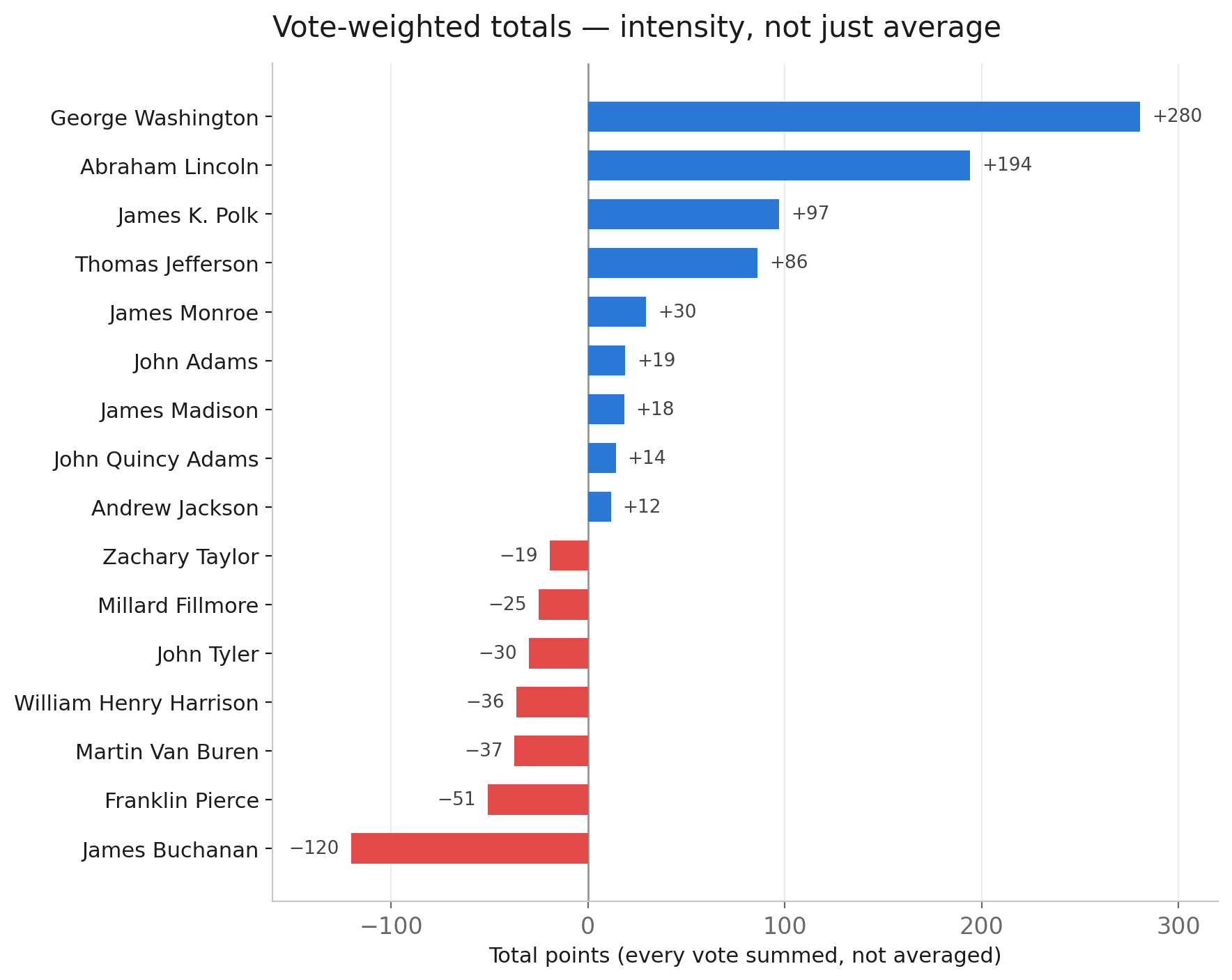
Of course, not every president inspires the same intensity of feeling. Who, in 2026, holds a truly strong opinion about Millard Fillmore? So if you switch from the average score to the absolute totals — simply summing every vote rather than averaging — you get a ranking weighted by how much people care.
What’s interesting is how little it changes. The only real movement: Polk overtakes Jefferson for third, and William Henry Harrison falls substantially — the victim of a great pile of C votes.
The breakdown, president by president
Here’s the full split of votes for each president, plus a few thoughts on each.
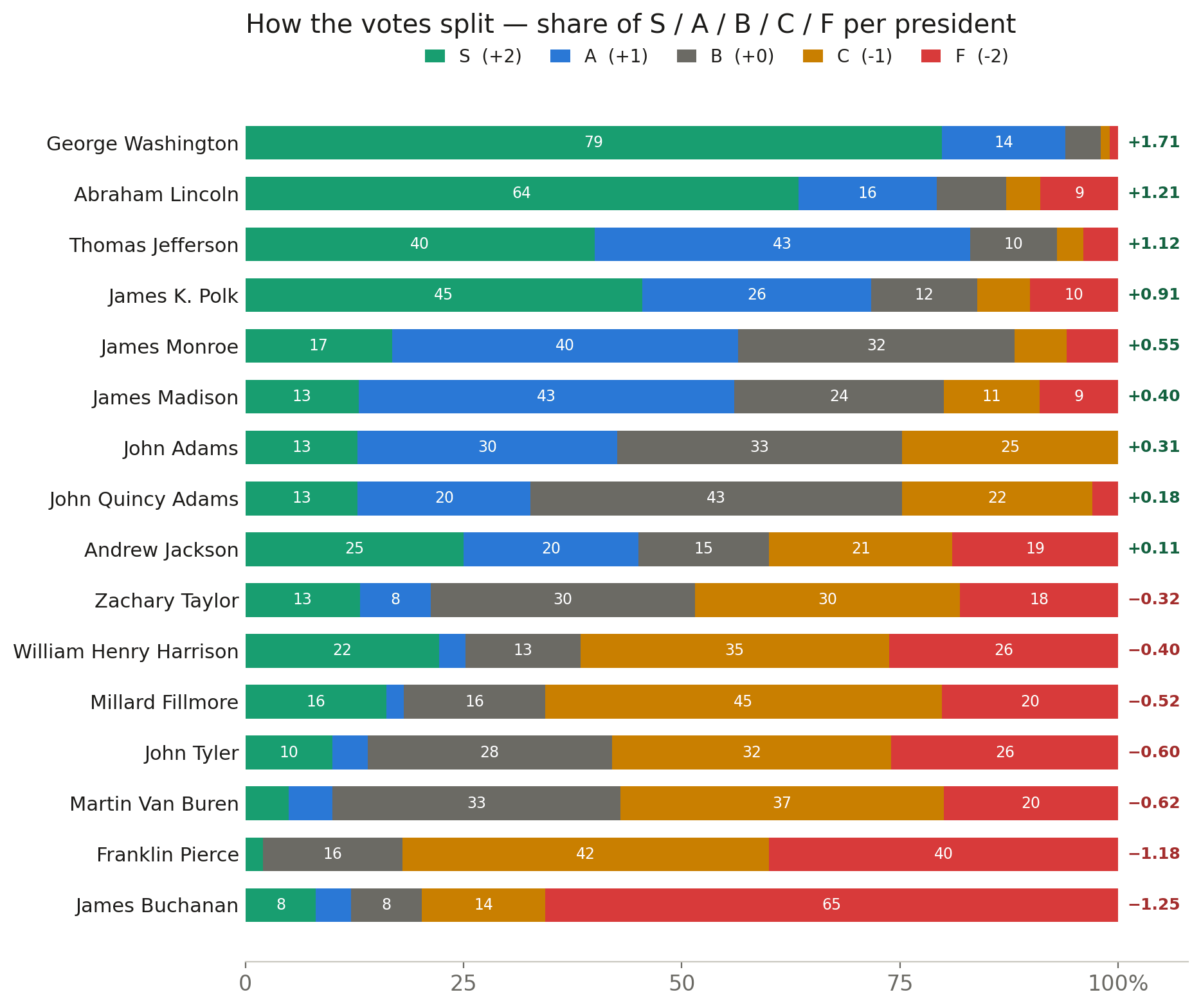
Going through them in order from “best” to “worst”:
George Washington (1789–1797): +1.71 (S)
The most lopsided result in the whole poll: 79% S. That tracks the historical and public conception well, since he is the father of our nation and truly a “Great” man. Little decent here from me.
Abraham Lincoln (1861–1865): +1.21 (A)
Historians almost always rank Lincoln first or tied for it, my audience had a somewhat wider spread, 9% giving him an F. Still his spot in second isn’t surprising.
Thomas Jefferson (1801–1809): +1.12 (A)
Jefferson has become more controversial in recent years due to his status as a slave owner, and the children he had with Sally Hemings. Still he was a transformational president and the Louisiana Purchase doubled the size of our country.
James K. Polk (1845–1849): +0.91 (A)
I’ve always had a soft spot for Polk. He is one of the only politicians in history to set out a clear set of goals, accomplish them, and then retire. I also happen to generally support his goals, the Mexican Cession, the Oregon settlement, a lower tariff, and an independent treasury.
James Monroe (1817–1825): +0.55 (A)
Well-regarded and low-drama. The “Era of Good Feelings” saw organized opposition collapse; the Monroe Doctrine warned Europe off the hemisphere for a century to come; and the Missouri Compromise bought the Union another generation of peace.
James Madison (1809–1817): +0.40 (B)
A founding giant who rates as a middling president. As father of the Constitution and author of the Bill of Rights, his pre-presidential résumé is unmatched — but the War of 1812 went badly enough that the British burned Washington, and his executive record never matched his constitutional one.
John Adams (1797–1801): +0.31 (B)
Squarely mid-tier. His proudest act was avoiding a full war with France. This is balanced against the Alien and Sedition Acts, which in my opinion was not good.
John Quincy Adams (1825–1829): +0.18 (B)
John Quincy Adams reached the White House through the disputed “corrupt bargain” of 1824 and as a result governed without a mandate. So he is a man standing astride history and yelling “no” no matter how you look at him, from slavery to democracy.
Andrew Jackson (1829–1837): +0.11 (B)
Andrew Jackson is the most polarizing figure in the poll unsurprisingly. Personally, I’ve always been a fan of him, because I think the sometimes democracy really does require a figure to clean house. But that was, as always, also paired with an unpleasant amount of filth and blood.
Zachary Taylor (1849–1850): −0.32 (B)
A war hero whose 16-month presidency is too short to fully judge. Notably, despite being a Southern slaveholder, he took a hard pro-Union line and opposed slavery’s spread into the new territories before his sudden death.
William Henry Harrison (1841): −0.40 (B)
Effectively unrankable — he died 31 days in. With no record to assess, the vote is mostly projection, which is why his error bars are among the widest and his pile of C votes sinks him in the weighted ranking.
Millard Fillmore (1850–1853): −0.52 (C)
Consistently low. He signed the Compromise of 1850, including the Fugitive Slave Act and dispatched Perry to open Japan. He is a man who clearly failed to read the mission of his times and instead tried to hold together a system which needed genuine reform.
John Tyler (1841–1845): −0.60 (C)
Near the bottom for most historians. “His Accidency,” the first VP to succeed a dead president, fell so far out with his own Whig Party that they expelled him. His main lasting act was setting the annexation of Texas in motion.
Martin Van Buren (1837–1841): −0.62 (C)
A master party-builder — arguably the architect of the modern Democratic Party — and a weak president.
Franklin Pierce (1853–1857): −1.18 (C)
A shell of a president, in my opinion, he signed the Kansas-Nebraska Act, which shattered the sectional truce and lit “Bleeding Kansas.” A Northern man with Southern sympathies who is widely judged to have accelerated the slide to war.
James Buchanan (1857–1861): −1.25 (C)
The worst score in the poll, and the historians’ standard pick for worst president. As states seceded after Lincoln’s election, he insisted secession was illegal but that he was powerless to stop it — and did effectively nothing. His 65% F is the exact mirror image of Washington’s wall of S’s.