Trump - S2E2: Dark Woke
Episode 2 of the Trump show has aired and it is a real step down in quality from the season premier. Alas. I hope they can break the tired formula but I fear they won’t.
Summary: The essay critiques Trump's "Liberation Day" announcement of reciprocal tariffs, revealing that the administration calculated tariff rates based on U.S. trade deficits rather than the other countries' actual tariff rates as claimed. Drawing a parallel to Critical Trade Theory—which applies Critical Race Theory logic to trade policy—the author condemns the administration for presenting a false mathematical framework as truth. While acknowledging that the underlying tariff approach itself is defensible, the author argues that Trump's bald-faced dishonesty undermines his credibility and threatens national stability, contrasting this with areas where Trump has succeeded through honest policy interpretation.
I am a temperamentally conservative person. I’m extremely grateful for the country I was born into in the late 1990s and am generally someone with strong tribal instincts—no doubt a product of my Mormon upbringing. So, I would be lying if I said there haven’t been aspects of the Trump administration that I’ve unabashedly celebrated. My feelings toward illegal immigration, racial preferences in university and professional hiring, and the outsized power of the managerial class are all so strong that it’s difficult to imagine myself being anything but dogmatically loyal to the political figure who has done the most for me personally of anyone in my lifetime1. As a 27-year-old White American, I directly benefit from Trump’s attacks on affirmative action. So the fact I routinely find myself being horrified by the coalition I should call home is deeply disheartening and I have much deeper sympathy for writers like Noah Smith than I ever had before.
For example, the recent “Liberation Day” fiasco has left me foaming at the mouth in blind rage, in a way that nothing else he has done has quite succeeded. Because everything I despised about Wokism—a refusal to engage with reality, the willingness to dress up lies as institutionally supported truths, and a broad sense of laziness in the face of the awesome duty of being the elite class of the most powerful civilization on Earth—is at play right now, again, on the national stage.
I’m want to in this article walk you through the fiasco because it is so absurd that it’s, frankly, hard to believe.
On April 2nd, Donald Trump came on stage to give a speech announcing “Liberation Day”.
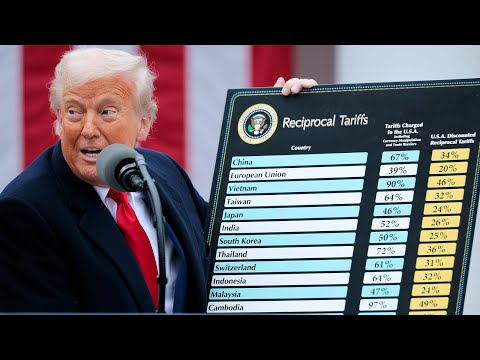
The goal of this spectacle was to announce a new regime of reciprocal tariffs, with the objective of bringing back manufacturing jobs to this country. At roughly the 20-minute mark, Trump is handed the following poster.
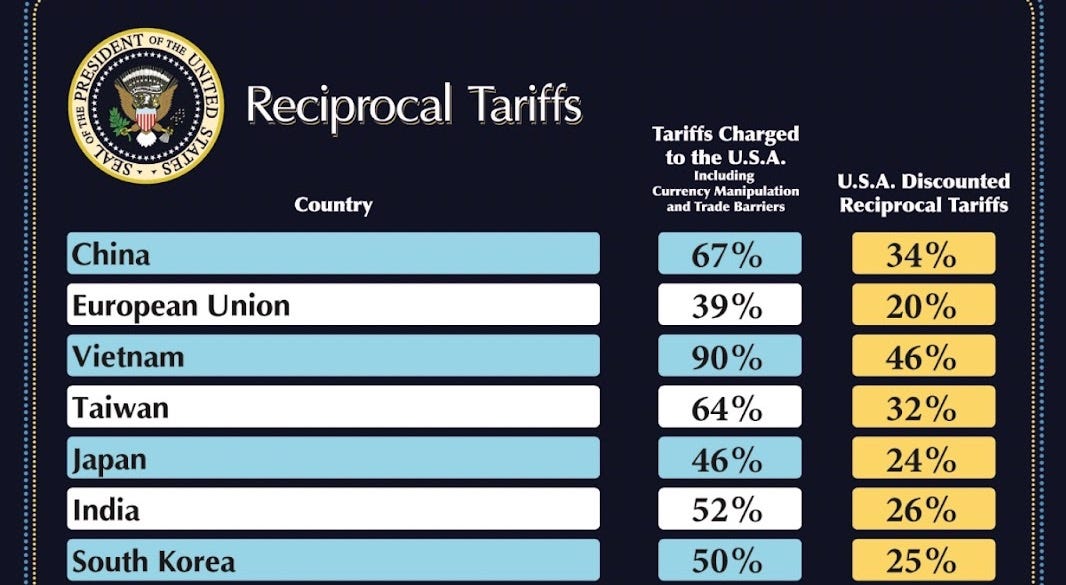
America appeared to have, generously, decided to levy tariffs at only half the level of other countries. But almost immediately, people began to realize that these numbers frankly didn’t make any sense. How, for example, notoriously protectionist countries like Brazil had the same calculated tariffs as a country like Singapore was unclear.
Until people all over Xitter began to realize2 the following:
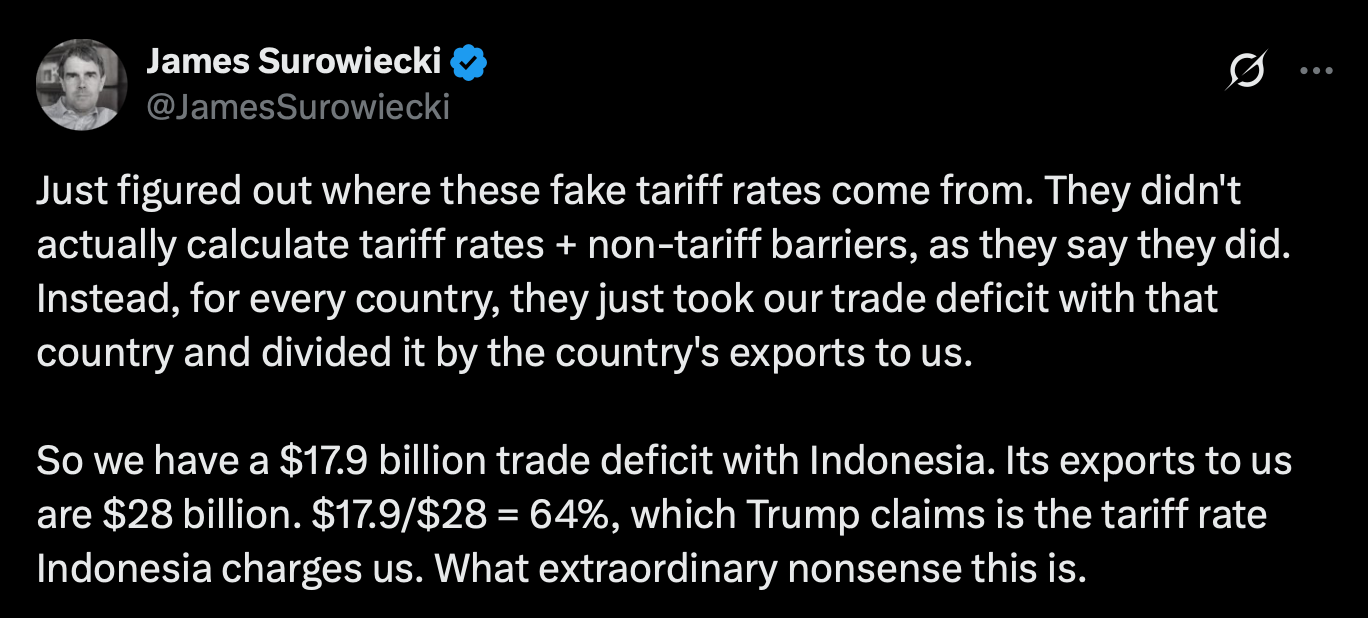
Or said another way, the Trump administration was taking the max(10%, Relative Trade Imbalance). In other words this had nothing to do with tariffs. To which a person might respond: technically, their tariff numbers include currency manipulation and trade barriers. I would simply retort: this is Critical Trade Theory!
I mean this with zero irony, it is the same argument used for structural racism in the US - all average differences between races are the result of racial discrimination. This is the basis of Kendi’s Critical Race Theory. In his own words, “racial inequity is evidence of racist policy”. Critical Trade Theory applies this same logic to US trade relations, where any trade deficit is seen as evidence of trade manipulation. Of course, both of these positions are insane to people who live in the real world. In the case of either racial inequity or trade deficits, obviously, racism and trade barriers play a role, but you would have to be genuinely blind to the realities of life to not realize that they are not the only factors.
In response to a growing number of people on Xitter mocking the Trump administration, Kush Desai—the White House Deputy Press Secretary—implied James Surowiecki was a liar and tweeted a link to the government’s own website describing how these tariffs are calculated.
The website showed the following:
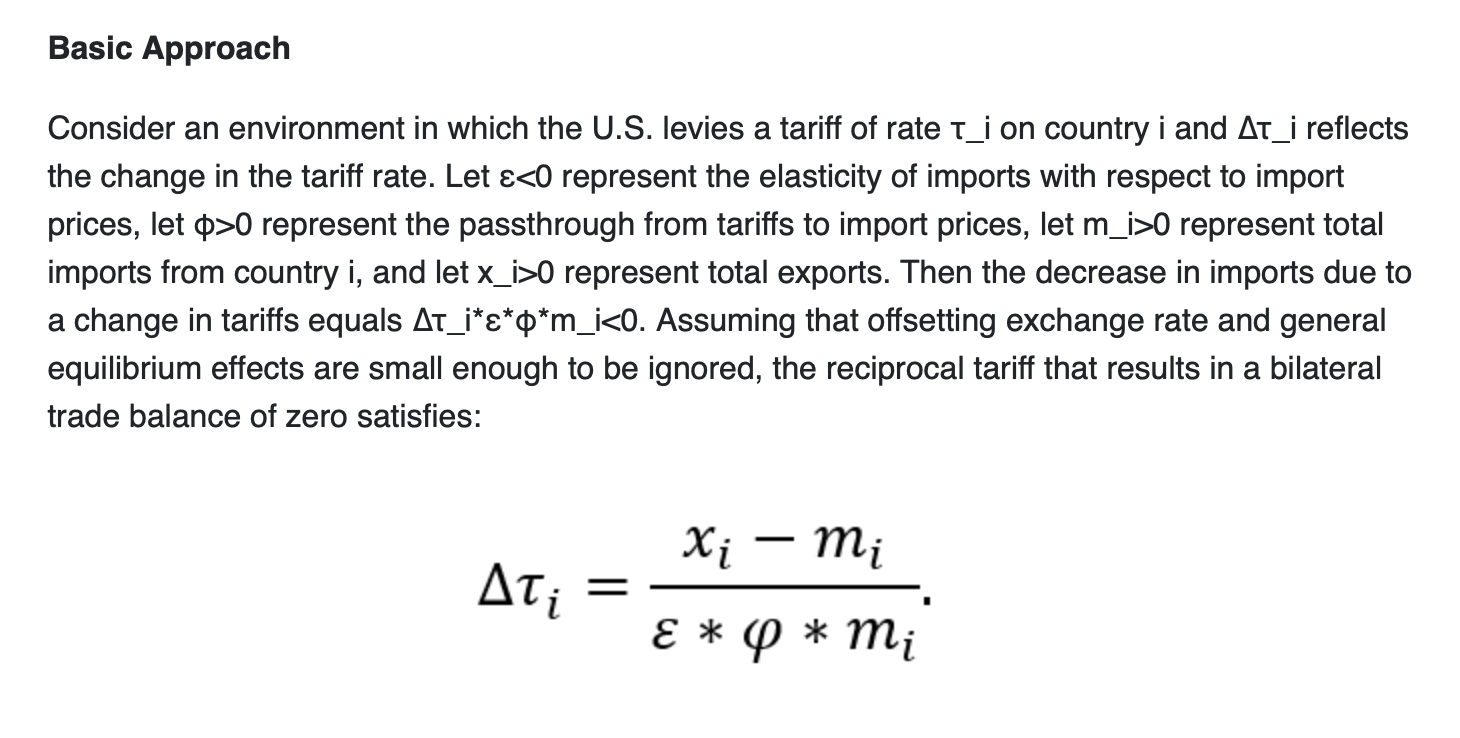
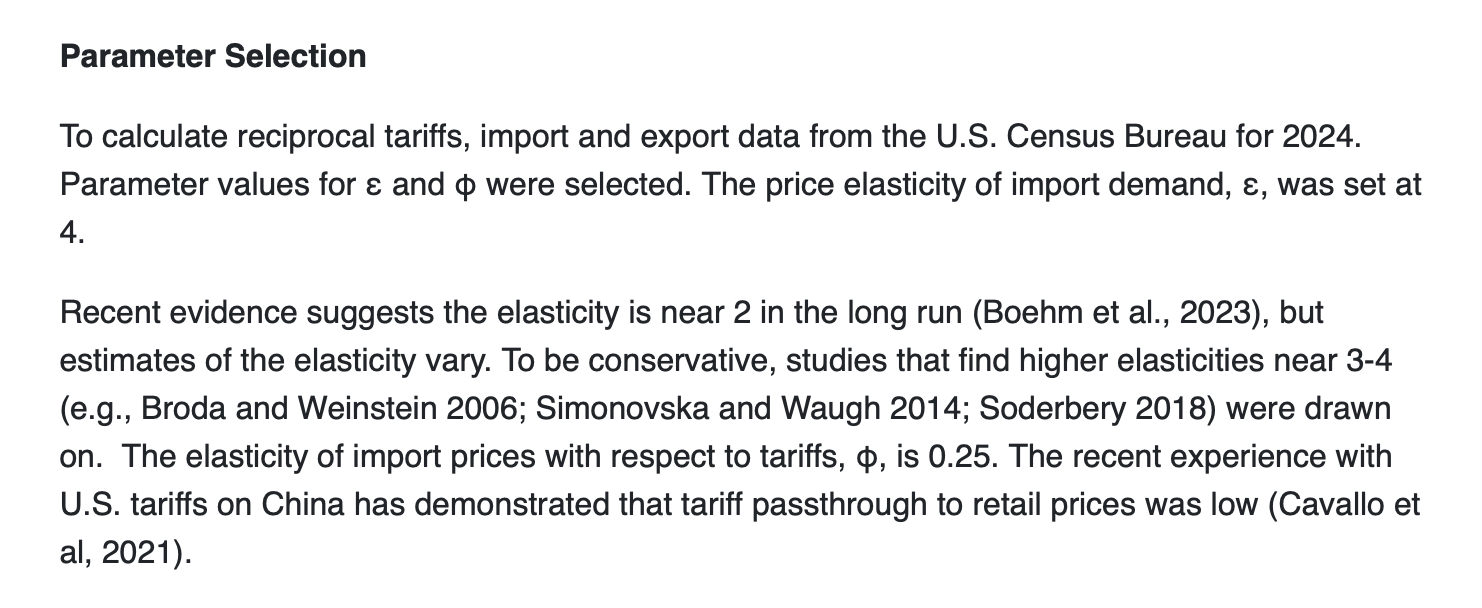
Now, lost in the Greek alphabet—which was obviously chosen to be confusing—and the strange mixed representation of indices is the hilarious fact that epsilon(4) and phi(0.25) cancel out. This means that this is a lot of fancy math to say that James is 100% right: “They didn’t actually calculate tariff rates plus non-tariff barriers, as they say they did. Instead, for every country, they just took our trade deficit with that country and divided it by the country’s exports to us,” which is objectively what they did.
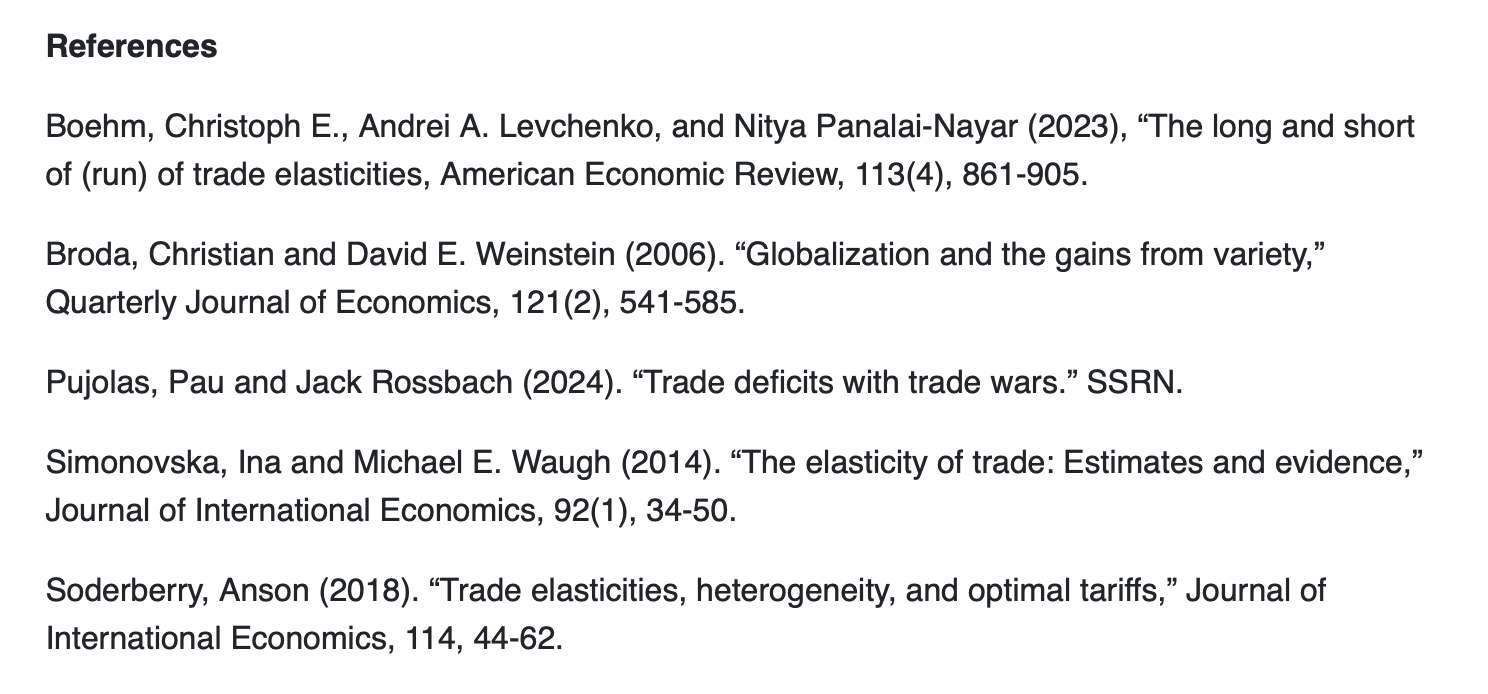
They do cite a couple of papers to find values for epsilon and phi, and I’ll say, to their credit, their values do seem to align with the results of the cited academic work. Although how they got 0.25 from Cavallo et al., 2021, is unclear.
But I have to assume they meant “Tariff Pass-Through at the Border and at the Store: Evidence from US Trade Policy” by Alberto Cavallo, Gita Gopinath, Brent Neiman, and Jenny Tang, since, for reasons I don’t comprehend, they have chosen to leave out any details about the paper in their references.
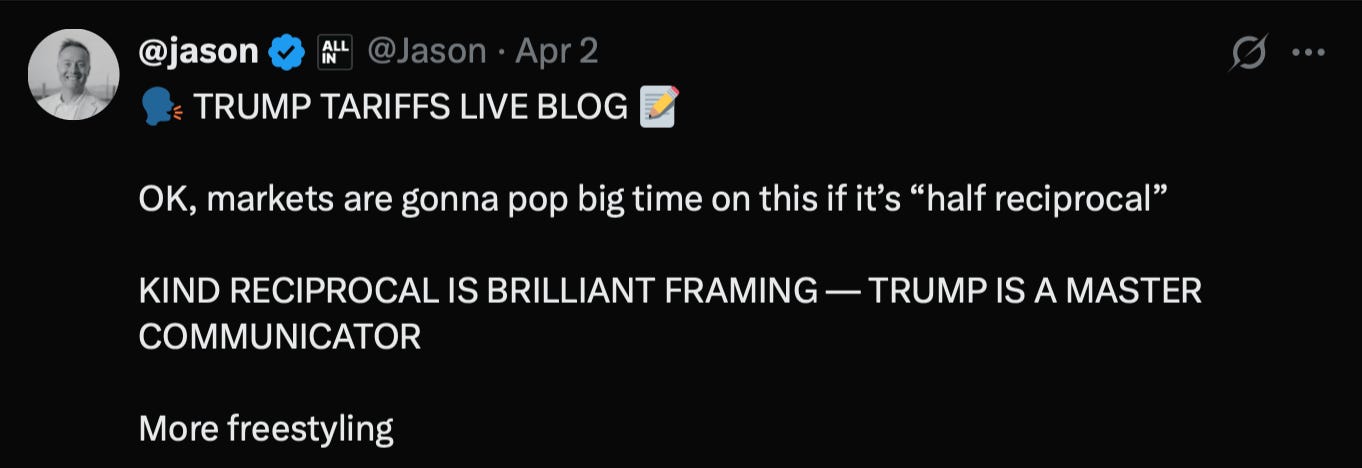
In response to this, the MAGA-adjacent crowd on Xitter took to their keyboards to defend our glorious President. Here is Jason—Silicon Valley investor, host of the All-In Podcast, and a previous Never Trumper—who gave the following glowing review, equipped with AI slop emojis and everything.
The truth is this: the new formula for determining US tariffs isn’t even that bad of a formula. If you wanted to set a base of 10% and then increase the rate in proportion to our trade deficit, this is literally what you would do. In fact, if you ask ChatGPT - as I did - it gives you this idea.
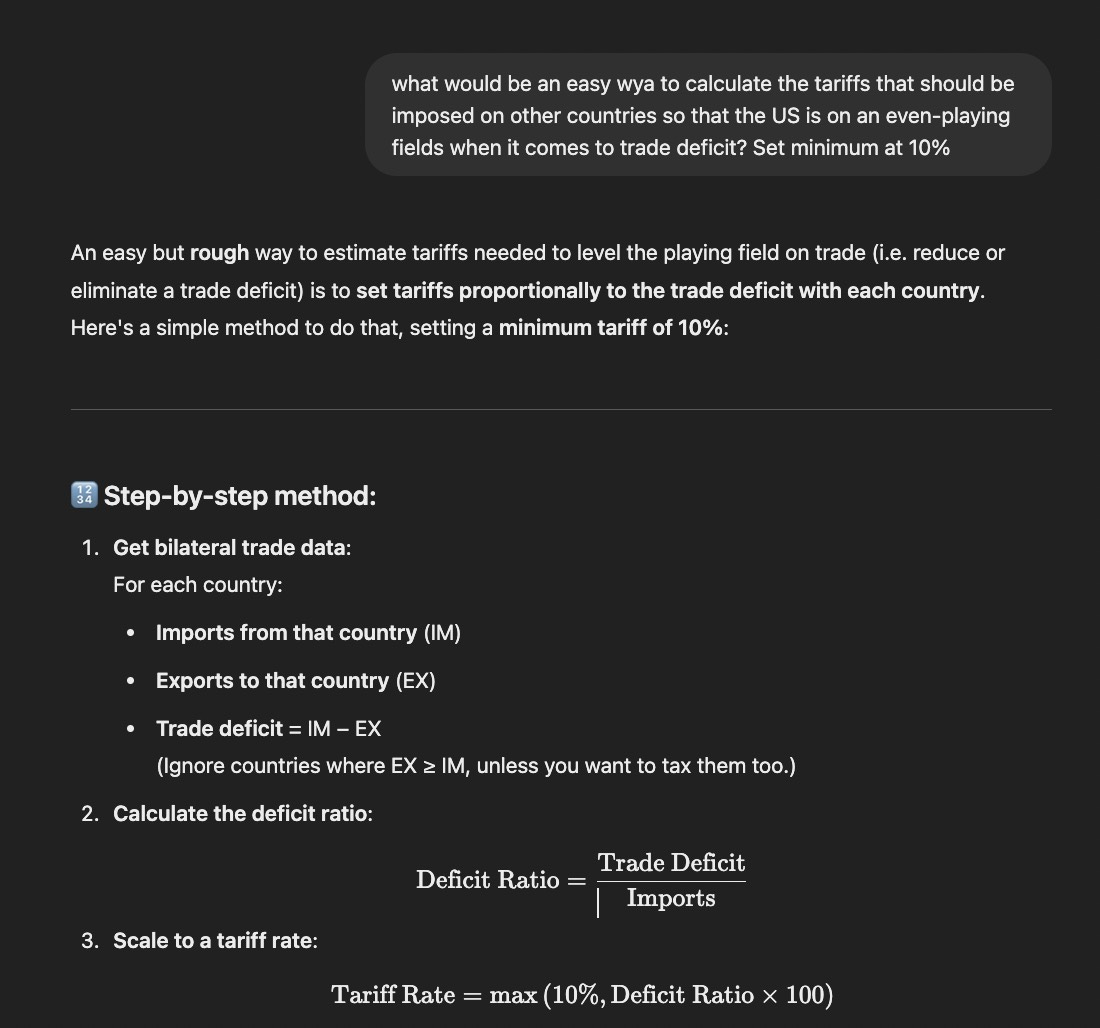
But presenting these numbers as the tariffs that other countries charge us is literally untrue. I don’t think we have ever had such an open and bald-faced lie before. Usually, when our politicians lie, they do it in a careful, subtle way. But Trump is so totally devoid of the shame any of us would feel for inventing nonsense that he is willing to just go on stage and say it. It seems like some Republicans are trying to push back—I saw a clip of Ted Cruz, for example, saying he was not a fan—but I doubt people will do anything about it. Tariffs are a consumption tax imposed only on imported goods, and the scale of taxes we are talking about is in the hundreds of billions of dollars a year. This is an enormous amount of money—and I would weep right now if I owned a factory in Vietnam—but I simply do not think it will crash the economy. Perhaps I will have to eat crow on this, but only time can tell.
What I know for sure is that lies are at the heart of almost all evil in this world, at least the fraction of evil that we contribute as Humans. Trump needs to stop lying so much if he doesn’t want to land in jail - or worse tear this country apart. He still has an enormous amount of goodwill from a broad swath of the country, as exemplified by his approval numbers.
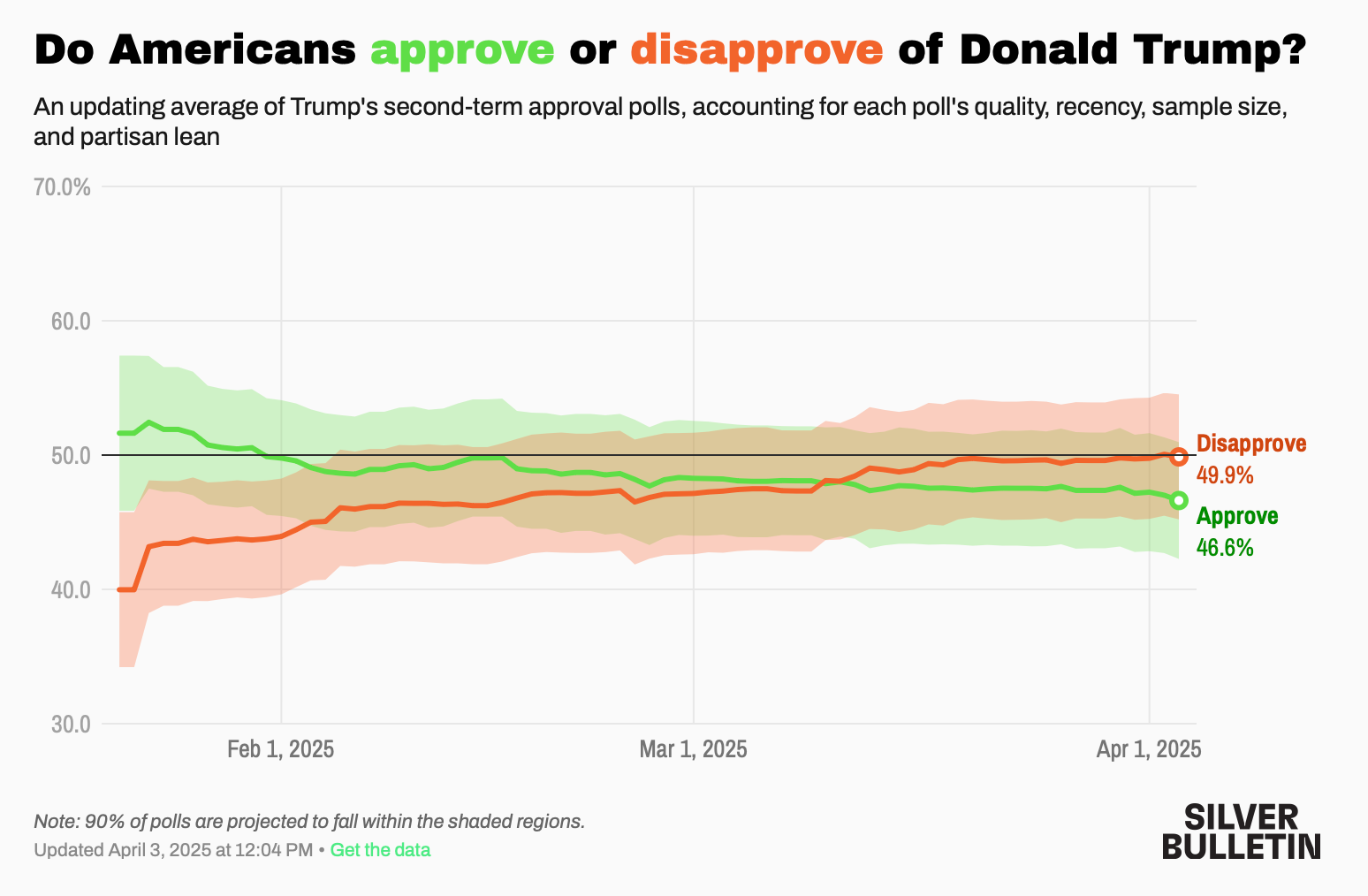
But the two areas where Trump has had success and remains broadly popular—DEI and immigration—are the ones where his policy reflects a more honest interpretation of the law. Maybe he should try this in other areas as well. There is an enormous amount of regulatory overreach, for example, I doubt people would be upset if he pruned it substantially. But continuing down this path of lies leads only to damnation.
If you have the money and would like to support me please sign up for a paid subscription!
As I explained in the previous article on Trump Season 2.
I first noticed it from journalist James Surowiecki(https://x.com/JamesSurowiecki