This is not our war.
Israel strikes Iran
Summary: Peter Banks discusses the June 2025 Israeli strikes against Iran, arguing that while Israel has the sovereign right to defend itself against perceived nuclear threats, the United States should not automatically become entangled in this conflict. He contends that lasting peace requires mutual agreement rather than military dominance, and that Americans should only engage militarily if Iran directly targets U.S. assets or civilians. The author frames this as a matter of sovereign state rights and consequences, emphasizing that prosperity and peace are interdependent, not zero-sum.
Before we begin, if you have no idea what I’m talking about and would like a quick summary of the events I’m discussing, feel free to check out this this one pager1 I had OpenAI’s Deep Research spin up for me.
I generally try to avoid talking about Israel/Palestine because, like most people, I have confused and complicated feelings toward the conflict. I’m a Plebeian Anglo-American, which means I’m neither Jewish nor does the message of global revolutionary overturning resonate with me. Still, the events of the war have been impossible to ignore, as I expect is true for many of you. My thoughts on the matter I intend to keep mostly private, at least for now, and so this essay does not attempt to adjudicate that issue at all.
But in light of the recent Israeli strikes against Iran, and the obvious influence of posting on the Trump administration, I feel compelled to state my piece.
First and most importantly, I pray for peace and prosperity for all of Mankind. If the last 100 years should have taught the world anything, it is that peace and prosperity are not a zero-sum game.
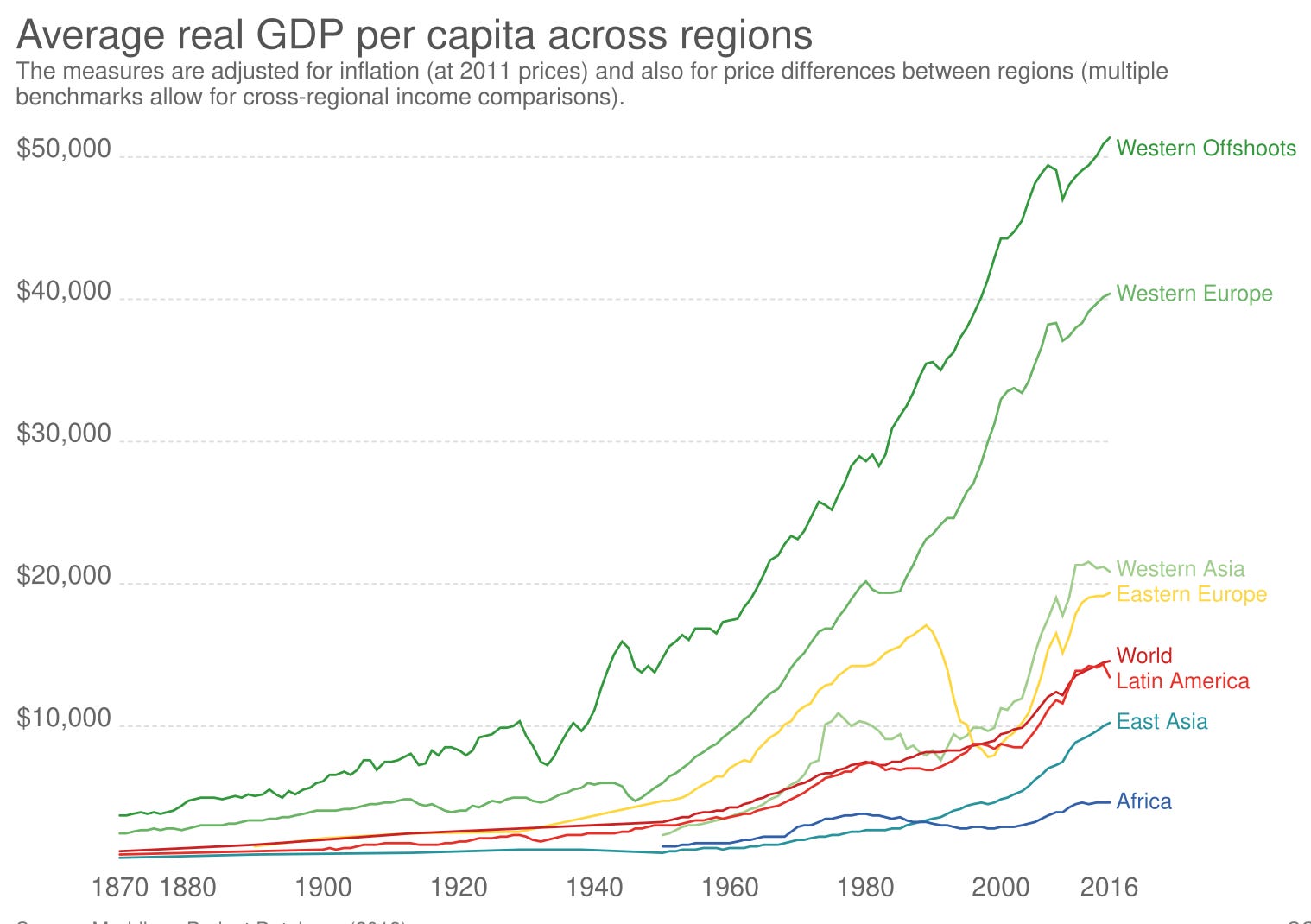
In fact, exactly the opposite is true: felicity breeds felicity just as misery breeds misery. There is little that would bring me more joy than to see the Islamic world rise to the level of Greece, let alone Japan. Israel cannot destroy or forever subdue the entirety of the Near East, nor does it appear that the Islamic world is capable of destroying Israel. Therefore, if peace is ever to be achieved, it must come through a just agreement that both sides can tolerate. Neither combatant seems even remotely interested in attempting such a peace right now; instead, they both appear eager to turn to the sword at the first opportunity.
Second, this is not our war. These are not our people. Israel is a sovereign state, which gives it—like all sovereign states—the rights and risks of freedom. It has chosen to exercise these rights by2 preemptively attacking Iran. The logic behind this move is that Iran’s pursuit of nuclear weapons poses an existential threat to the Israeli state and that the window for action was closing. To quote Rubio:
Israel advised us that they believe this action was necessary for its self-defense.
I’m willing to accept that this is how the Israeli government feels. However, not only is this not our war, it appears that they acted against the desires of the Trump administration. Earlier on Thursday, the President said the following:
As long as I think there will be an agreement, I don't want them going in
In addition, after the strikes Rubio said:
We are not involved in strikes against Iran and our top priority is protecting American forces in the region.
Only time will tell the extent of the “green light” America provided or the level of advanced warning we received. Regardless of these historical nuances, Israel bears the heavy crown of sovereignty and now assumes the risks associated with the war it has initiated.
Unless Iran targets Americans assets or civilians intentionally Trump should endeavor honestly to stay out of the fight. This is not our war.
Israel–Iran Conflict (Mid-June 2025)
June 13, 2025 (UTC) – Israel launched a broad pre-emptive strike campaign against Iran, hitting military and nuclear sites in what Prime Minister Netanyahu dubbed “Operation Rising Lion.” Iran’s IRGC reported the death of its commander, Gen. Hossein Salami, and multiple civilian casualties in Tehran. Supreme Leader Ayatollah Khamenei condemned the raids as “wicked and bloody.”
Israeli Actions
National emergency declared; Ben Gurion Airport closed and El Al suspended flights.
Reserve mobilization: “Tens of thousands” of troops called up to avert an “existential threat.”
Warnings issued: Any Iranian or proxy retaliation “will meet a heavy price.”
Iranian & Regional Response
Airspace closures: Iran and Iraq shut their skies; commercial airlines rerouted flights to avoid the region.
Market reaction: Oil prices spiked; global stock futures dipped on fears of escalation.
Tehran’s vow: IRGC spokesperson threatened Israel and the U.S. would “pay a heavy price” (accusing Washington of complicity).
U.S. & U.N. Reactions
U.S. NSC meeting: President Trump convened the National Security Council on June 13.
Official stance: U.S. denies involvement; Secretary Rubio warned Iran not to target U.S. interests.
Safety advisory: State Department urged all U.S. personnel in Israel to “shelter in place.”
U.N. appeal: Secretary-General Guterres called for maximum restraint to prevent wider war.
Global Diplomatic Context
Nuclear talks in Oman (scheduled June 15) remain “on track” despite the strikes, per Omani mediators.
International calls for de-escalation:
Australia’s FM Penny Wong: “Alarmed by the escalation.”
New Zealand PM Christopher Luxon: Warned of high risk of “miscalculation.”
Intelligence Claims
Israel: Cited new intel that Iran was “approaching the point of no return” on weapons development.
U.S. agencies: Report no recent change in Iran’s nuclear posture; Khamenei has not green-lit a weapons program restart.
Sources
“Israel says it strikes Iran amid nuclear tensions,” Reuters, June 13, 2025.
“After Israel strikes Iran, airlines divert flights, airspace closed,” Reuters, June 13, 2025.
“Live updates: Israel strikes Iran’s nuclear and military sites,” AP News.
“World reacts to Israeli strike on Iran over nuclear programme,” Reuters, June 13, 2025.
From what appears to be true right now as I write these words on June 12th