The Ballot-Box Empire
More of the Americas should enjoy our culture and institutions. Instead of endless immigration, we can do this by formally expanding the American empire through the ballot box.
Summary: The essay argues that if American institutions are morally superior enough to justify open immigration, this logic should extend to allowing countries in the Americas to democratically join the US as integrated territories. The author proposes an 'imperialism of the ballot box' where populations could vote for integration and gain citizenship rights while becoming part of American governance. This arrangement would address global inequality more effectively than migration alone, transforming imperialism into a mutually beneficial system.
In light of the recent discourse around “high-skill immigration,” I’ve been reflecting on how much “morality” influences how Americans perceive immigration. By morality, I mean that many Americans (not to mention aspirational Americans) strongly believe it is “unfair” that some people enjoy this country’s capital and political institutions while others do not. Therefore, we have an obligation to extend these advantages to as many of our fellow Humans as possible. Their argument goes something like this:
On a basic level, all sentient creatures have moral worth. Among humans, the variation in moral worth is extremely small. Yet people’s material and social circumstances vary enormously. Economically, it appears that when a person migrates from a very low “habitability” zone to a high “habitability” zone, they do not undermine the new zone’s habitability. Yes, they may not achieve the same levels of success, on average, as the local population, but the net effect is undeniably positive. Because the physical and human capital is so much higher, and our institutions are so much better, the same person can achieve a level of flourishing here that they could never dream of at home.
Given the above, we, as Americans, have a moral obligation to grant everyone who wants it the right to move here and enjoy what we have inherited—since, at the end of the day, we did nothing to earn that inheritance (à la the Veil of Ignorance).
To really condense the logic above: because America is so much wealthier, with vastly superior human rights and material conditions, simply not being allowed to live in the West is a crime against humanity1.
However, this logic cuts both ways. If American institutions are truly so vastly morally superior, why should they remain limited to these borders? The answer you will usually get is that colonialism is irredeemably evil and has zero virtues. Writing this puts my employment at risk, but as a White American in California, I cannot accept the premise that colonialism is always evil. No—that would mean hating myself and believing that this land would be better off in the hands of the Mexicans, the natives, or some other marginalized group. But I don’t believe that. I like California. Everyone, including Mexican-Americans, is better off because we are ruled from Washington rather than Mexico City. No, colonialism is not always bad.
But even if it were—even if there were no setting in which imposing your legal and political system could ever be ethically neutral or let alone beneficial—anti-colonialism can’t be the only value for ontological morality. Consider migration again. Even if we accepted huge levels of movement, there would still be billions of people left at home, in what you, dear secular humanist, consider a morally intolerable situation. Should we simply accept, forever, a trickle of humans escaping the crushing poverty of the third world?
This is why I propose a new form of Imperialism—an imperialism befitting a country as moral and powerful as America. An Imperialism of the ballot box.
Ideally, every country in the Americas would be able to hold a referendum. If 50% of the adult population—not just the voters—choose to join America, they would enter into a new arrangement. In many ways, it would resemble the current structure with Puerto Rico. The residents of this new territory would become U.S. citizens but would be unable to vote in federal elections while at home. However, they could move to the metropole at their discretion. Like all U.S. territories, they would be bound in a perpetual bond of fraternity. The state’s monopoly on violence would shift from their old capital to Washington. Laws and institutions would be shaped by the imperial core until the territory reached a predetermined threshold of social and economic development and could fully join the sacred order of the states.
This is the trade: citizenship and aid in exchange for fraternity and empire.
I genuinely believe vast swaths of the Americas would gladly join the U.S. If for no other reason than millions of people prove this by risking everything to come here.
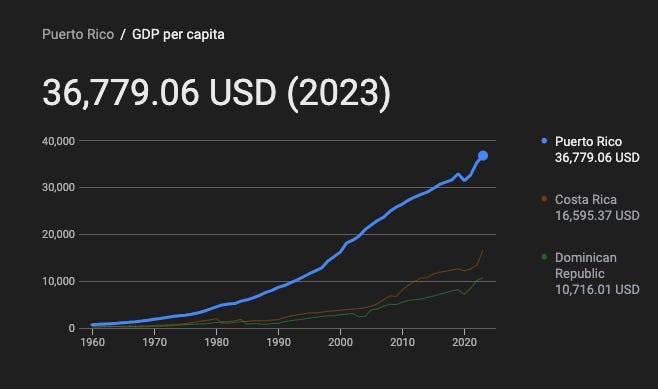
To see how beneficial this arrangement can be, just look at Puerto Rico. Although, shamefully, Puerto Rico has never been granted statehood, it has done extremely well as a formal part of the American Empire. The numbers below ignore the millions of Puerto Rican residents who moved to the metropole.
In short, I agree that more of the world should get to enjoy the privileges of American culture and politics. In fact, I would argue that the entirety of the Americas should enjoy these privileges. But we do not need to force anyone’s hand, nor do we need to accept an unlimited wave of migrants simply out of a shortsighted sense of sympathy. Instead, I truly believe that the millions of people throughout the New World who want to become Americans should have that desire honored in a mutually beneficial way.
Btw if all of this sounds absurd to you please keep in mind that it is the official policy of the European Court of Justice.