Reflections on Politics in the UK
Political realignment arrives in Britain
Summary: Peter Banks examines the rise of Nigel Farage's Reform UK party and the collapse of mainstream British politics, arguing that voter frustration with immigration and housing costs—issues the political establishment has failed to address—is driving political realignment. Labour's government under Keir Starmer won a landslide in 2024 despite receiving fewer votes than Jeremy Corbyn's defeated campaign, revealing that the victory was less about Labour's appeal than the fracturing of its opponents. The essay analyzes each major party's likely trajectory and predicts UK politics will eventually consolidate into two stable coalitions organized around competing visions: secular-humanist cosmopolitanism versus nationalist priorities.
Before I proceed I want to make something clear. I love following UK politics so I’d like to believe I know at least a little bit about the country. But I do not live in the UK, nor have I personally lived there for any length of time. As an American, I’m well versed in autistic and genuine outsiders interjecting their opinions, but it’s always apparent who has truly lived in this country and who has not, since outsiders miss little things. What I do appreciate, though, is the perspective they are ought to bring to my own nation’s politics. This essay’s value will thus be from my perspective and not my personal experience.
I don’t know how closely y’all have been following UK politics lately, but things aren’t going well for the mainstream parties. Almost a year ago, the UK held a general election in which Keir Starmer led the Labour Party to a landslide (in seat share) victory, ending 14 years of Tory rule. However, the seat numbers obscure the fact that Starmer won less due to his own popularity and more due to the collapse of his opponents. If you look at the raw vote totals, Starmer did worse than Corbyn in 2019 when Johnson crushed him. The collapse of the Conservative vote was primarily driven by a large share of the electorate—14%—voting for Farage’s Reform UK party - only won five seats due to the inefficient distribution of their vote.
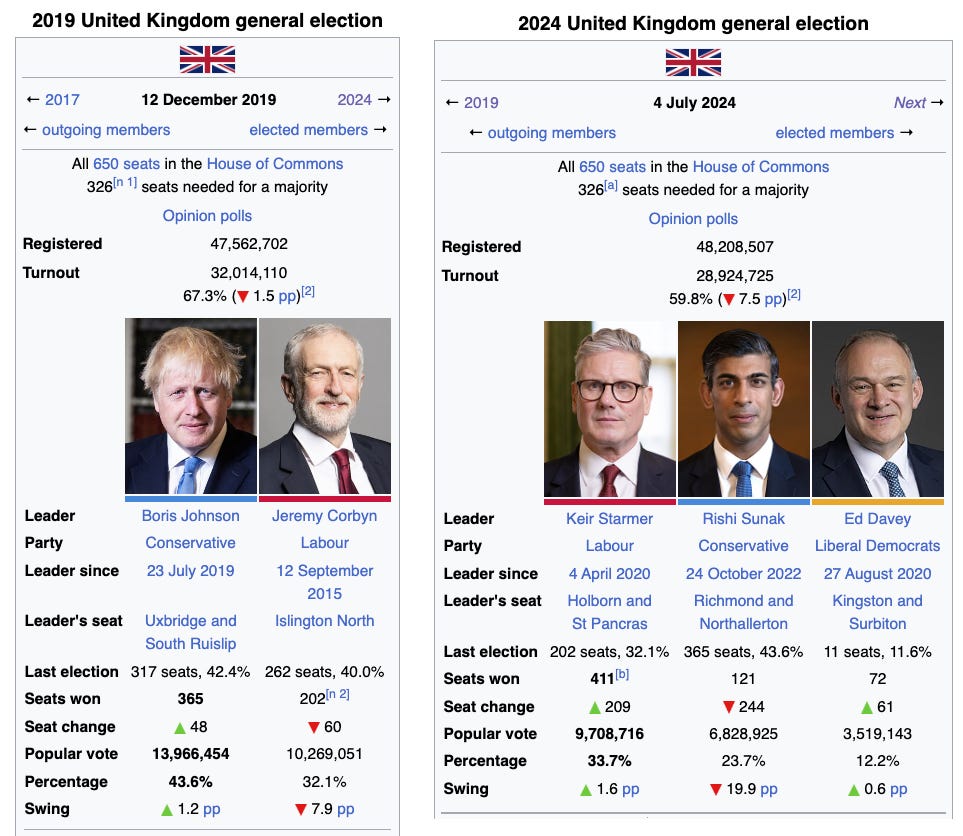
In other words, Starmer was always facing an almost existentially difficult set of problems with only a transient base of support. We are told to picture Sisyphus smiling, maybe Starmer could try a little of that sometimes. Even when taking this rocky position into account, Labour has failed to deliver on its promise of real policy or psychological change. The UK remains stuck in the same doom loop it’s been in since Brexit. Labour has plunged in the polls and now trails Reform, whose lead continues to grow.
It’s increasingly looking like, if the election were held today, Reform could not only win the most seats—but might actually win an outright majority. Farage could therefore govern without any dependence on the existing political establishment. I’m not sure if the UK is ready for a Trumpian-style takeover of its administrative apparatus. Nevertheless, I would expect a Reform-led government to be a lagged and watered-down version of whatever is currently happening in America.
Farage’s rise seems overwhelmingly driven by the skyrocketing cost of living—especially housing—and immigration.
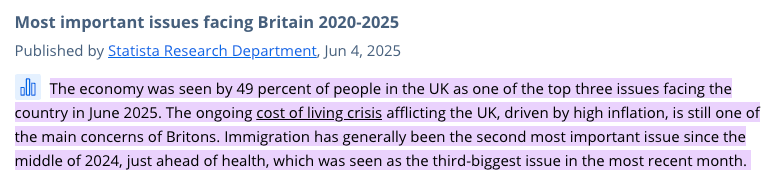
These issues, in a constrained supply environment like the UK’s, are so obviously interconnected that the political mainstream’s denial of this fact is almost insulting. Farage, who strikes me as a political opportunist at heart, has seized on this frustration and is using it as a cudgel to beat all his opponents.
Because the major parties were so slow to admit the basic economic truth—that if you hold supply constant but increase demand, prices rise—more and more voters are turning to politicians perceived as untainted.
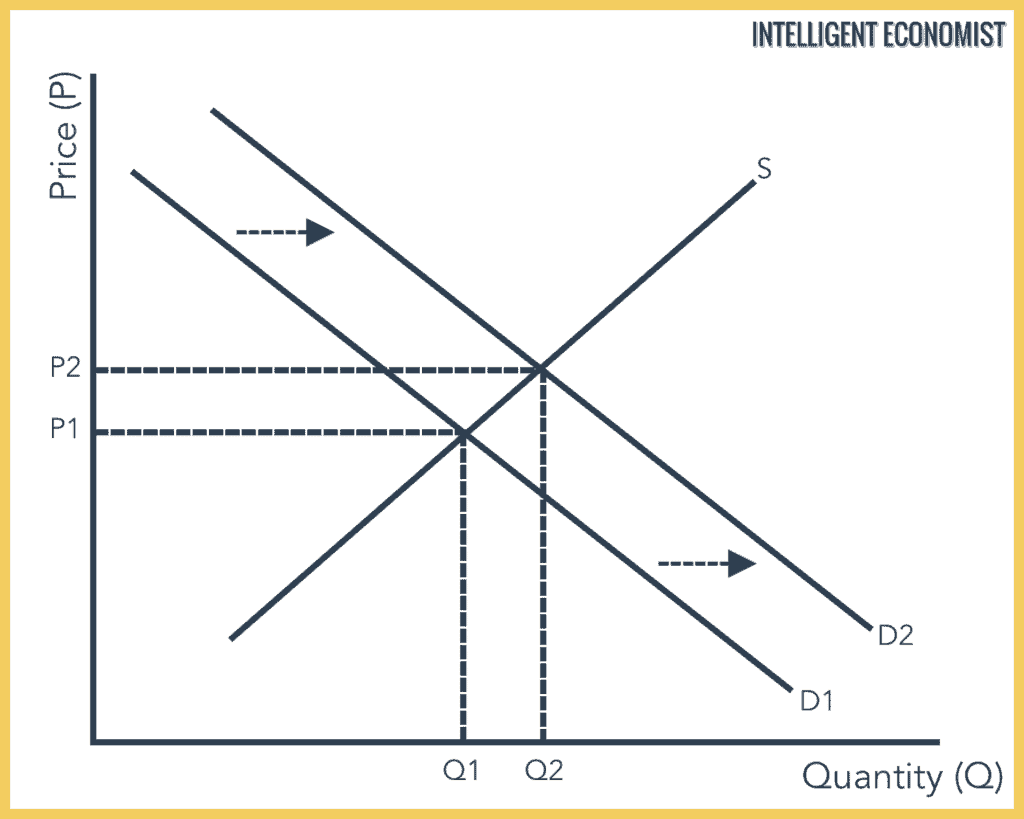
In this case, voters seem to be coalescing around two main interpretations: either an “abundance”-style liberalism (e.g., the Lib-Dems), which argues that the crisis is caused by artificially constrained supply and that the solution is to boost housing construction rather than reduce immigration; or a Reform-style nationalism that holds immigration has been, likely, a net negative for native Brits’ incomes and quality of life, and thus should be reduced, regardless of what happens to housing supply.
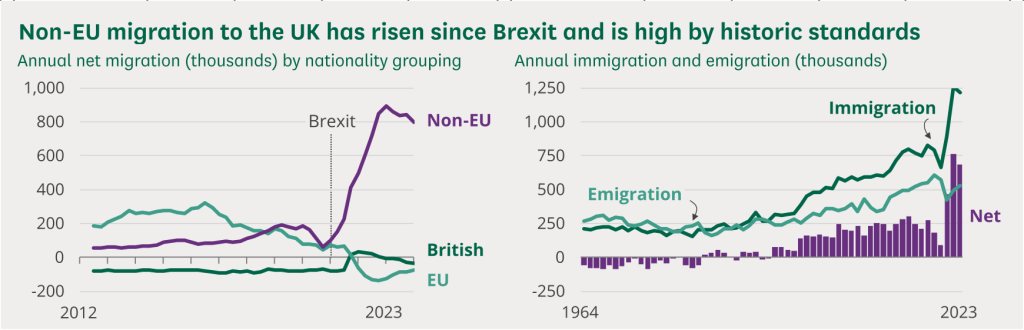
What was already a difficult conversation has been accelerated by the enormous surge of non-Western migration to the UK in the aftermath of the COVID pandemic. This surge is often referred to online as the “Boris wave,” after the Conservative PM at the time.
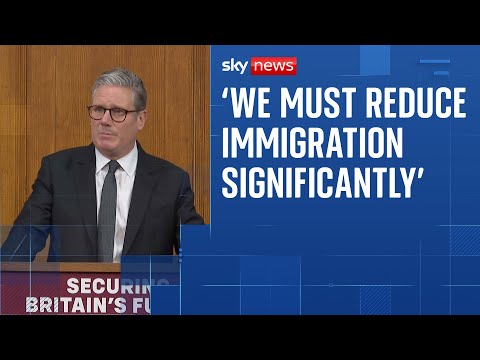
A recent blowout of the establishment parties in local elections has finally forced Starmer and Labour to reckon with the scale of the problem. In response, the PM gave a speech warning that the country must avoid becoming “an island of strangers.” This, of course, opened him to attacks from both the left and the right—the eternal burden of centrism.
It is my belief, as outlined in this essay, that immigration likely causes political unrest on expectation in any country that experiences it. This is a soft idea I’m still thinking through, since obviously it can’t be the only explanation for instability in developed democracies. South Korea, for instance, faces many of the same issues as the UK but has virtually no immigration. Still, in the U.S. and UK at least, immigration seems to have destabilized the political systems that emerged after the 1970s inflation crisis. In the U.S., this is referred to as the Sixth Party System. The emerging coalitions appears to be structured around a broad divide between secular-humanists and nationalists.
In the UK, this has resulted in a transient four-party system. First-past-the-post voting naturally pressures electorates toward two-party consolidation—not because of any conspiracy, but due to the steep costs of vote-splitting. Just look at the 2024 election; this configuration can’t last long. Eventually, two stable coalitions will emerge: one “left,” one “right.” Since predictions are fun—especially with error bars—here are my current guesses and probabilities on who will win:
Left:
Greens (>1%)
Labour (~70%)
Lib-Dem (~30%)
Right:
Reform (50%)
Conservatives (50%)
Let me explain my reasoning a little.
Greens:
Lol.
Liberal Democrats:
You can think of this party as analogous to the Pete Buttigieg wing of the Democrats in the U.S. Their most important and consistent ideological position is cultural liberalism, and they’re willing to compromise on almost everything else in service of it. Take economic policy, for example. The Lib Dems have no issue being pro-abundance, pro-market, pro-welfare, or pro-whatever-is-popular—but it would be inconceivable for them to campaign against immigration or trans rights. If you want to check where they stand on various issues, here’s their website.
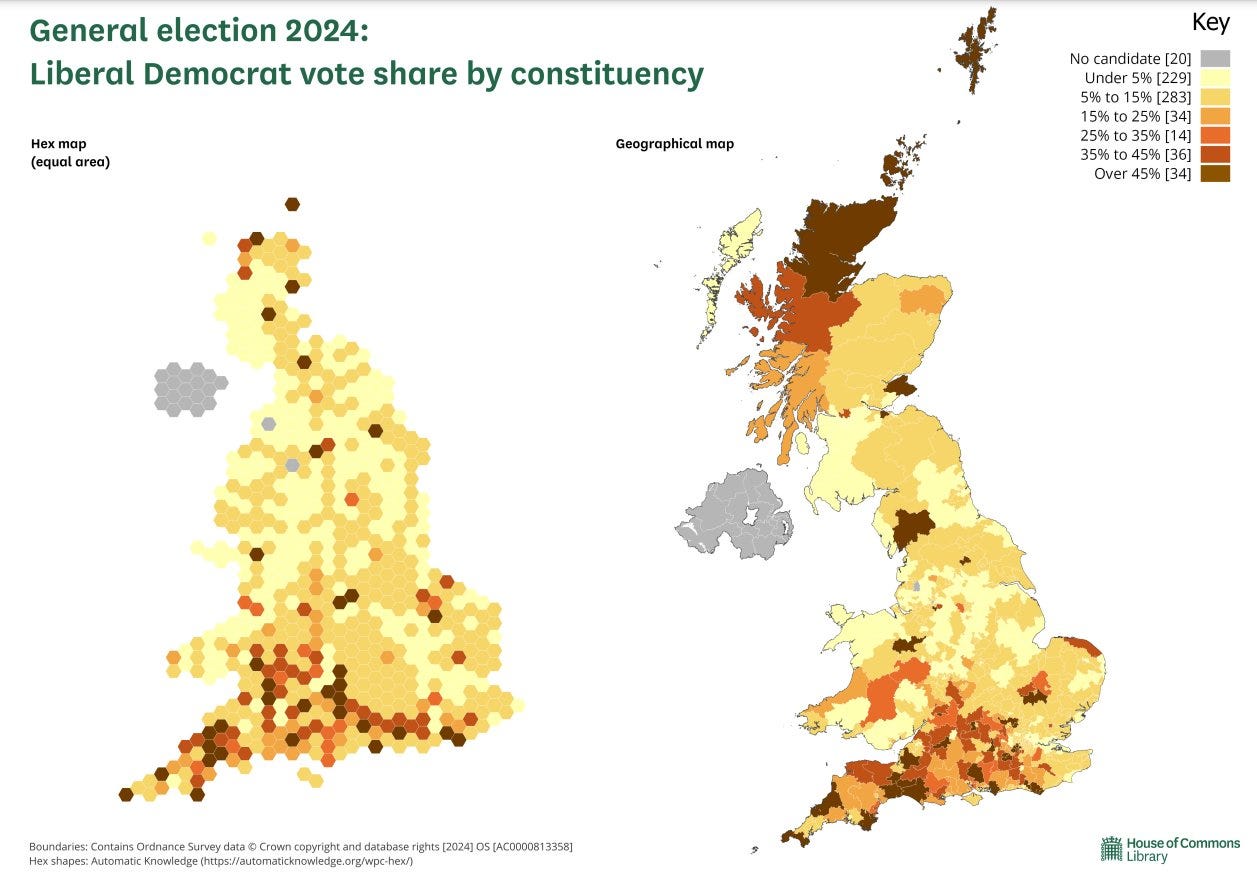
As you can see from a map of their vote share, they tend to perform well in the South West of England—a region that did relatively well during the transition from imperial industrial core to financial periphery in the globalist era. They also do well in the Highlands of Scotland, for reasons I don’t fully understand.
Similar to Reform, the Lib Dems reflect a legitimate political impulse, rooted in the material conditions of their voting base. Their supporters sincerely believe in secular humanist progressivism and are often employed by large multinational firms in and around London. Many are affluent migrants or the children of migrants, for whom cosmopolitan, global Britain is their only home. As the Labour Party continues to unravel, these voters will need a new group to represent their interests—and the Lib Dems seem like a plausible candidate.
It feels strange to make this comparison, but I think Bismarck and Prussian militarism offer a surprisingly good analogy for the cosmopolitan elite—let’s call them libs—of the Anglo world’s affluent, progressive, white-collar email-job class. Much like the Junkers, who profited immensely from the unification of Germany and the primacy of the Prussian state, libs have been the chief beneficiaries, within the West, of the creation of a single, interconnected global market for goods and labor. As a result, they want to preserve the specific political and cultural systems that make their empire possible, even as they’re willing to compromise on secondary issues to maintain this core objective.
Given that the moral foundation of this system is a collection of secular humanist beliefs—about the purpose of life, the meaning of progress, and the role of the state as guarantor of individual rights—this worldview seems likely to form one of the major poles around which politics will continue to organize. The Lib Dems are a natural contender to lead the “left” pole of that system.
However, what will hold them back is the issue of sincerity. Even if they run promising to shower voters with unlimited welfare—funded by economic deregulation and high-skill migration—voters will sense they aren’t serious. They are, and will likely remain, the party of yuppies—a small minority of the country.
Conservatives:
The Conservatives—or Tories, as they’re often called (British people have a habit of giving things strange names—mincemeat comes to mind)—are arguably the oldest political party in the world. Most recently they governed the UK from 2010 through 2024, and those years are broadly considered—putting it kindly—to have been a disaster for the country. Their modern form is largely a product of Thatcherite neoconservatism, which in many ways functions as the inverse of the Liberal Democrats. If the Lib Dems are singularly focused on cultural issues and flexible on everything else, the Conservatives are the opposite: singularly focused on slashing state capacity and willing to compromise elsewhere. That’s without even touching on their handling of Brexit—a referendum they themselves scheduled. Rather than moving decisively after David Cameron’s resignation, the party has cycled through leaders at an absurd pace—most humorously with Liz Truss lasting less time than a head of lettuce.
If it sounds like I’m being harsh, that’s because I am. A glance at UK GDP per capita data says everything that needs to be said about a party that claims to be laser-focused on economics.
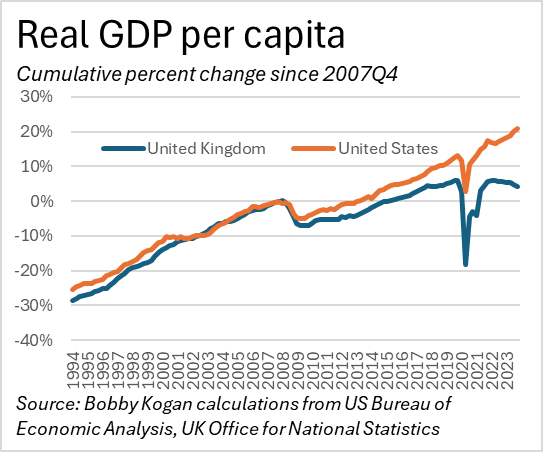
I’ve heard talk that the party might bring back Boris Johnson, who did well in 2019, and that this could potentially turn things around. Although I’m skeptical—Johnson’s appeal seems spent, and I expect he would flop. The current leader, Kemi Badenoch, is a Black woman who spent much of her early life in Nigeria—something that undeniably hurts the party’s appeal with its increasingly nativist, right-wing base.
Still, I wouldn’t fully count the Tories out. The runner-up in the last leadership race was Robert Jenrick, who resigned from Sunak’s government over immigration policy—claiming it wasn’t strict enough. Who knows? Maybe he can turn things around. Farage is still a deeply unpopular man, and I’d say it’s a true coin toss whether Reform implodes before the 2029 election. If it does, the Tories would likely win almost by default.
Labour:
Labour was the big winner of the Conservative collapse in the 2024 election. They chose to run Keir Starmer, a centrist technocrat from the Blair wing, who substantially moderated the party. As a reward, they received fewer votes than Corbyn—and won a landslide number of seats. Since the Tories were so deeply despised by the electorate, and the conservative vote was split between two parties, Labour was able to unite working-class native Britons and urban cosmopolitans around the shared campaign message of “fuck the Conservatives.” But that’s not a governing platform.
As a result, holding this coalition together while actually making difficult decisions has proven more challenging than many expected. Starmer, in true centrist fashion, has opted for a strategy that seems to offend every faction simultaneously. Working-class Brits and pensioners have been hurt by cuts to welfare. Urban Britons have been alienated by the rightward shift on immigration. The Muslim ethnic vote is angry over Labour’s support for Israel. And cultural progressives are furious about the party’s recent retreat on trans inclusion.
As a result, the party is dropping like a rock in the polls. Unlike the Conservatives, who face a powerful and organized Reform Party, Labour remains the de facto left-wing party in the UK. More important than shifting public favor is that Starmer still holds commanding control of Parliament, with a full four more years of runway in this term.
In short, Labour has made a number of unpopular decisions early, and they still have the time and institutional power to profit if those decisions pay off. If, for example, irregular migration declines or the state of public finances improves, Labour will earn the credit for those outcomes.
Where they truly struggle, though, is in their complete lack of an obvious telos. Labour isn’t consistently culturally liberal like the Lib Dems—alienating a substantial portion of the electorate that only really cares about cultural issues—but neither are they aggressively pro-subsidy enough to reliably win over the welfare-reliant vote.
Reform:
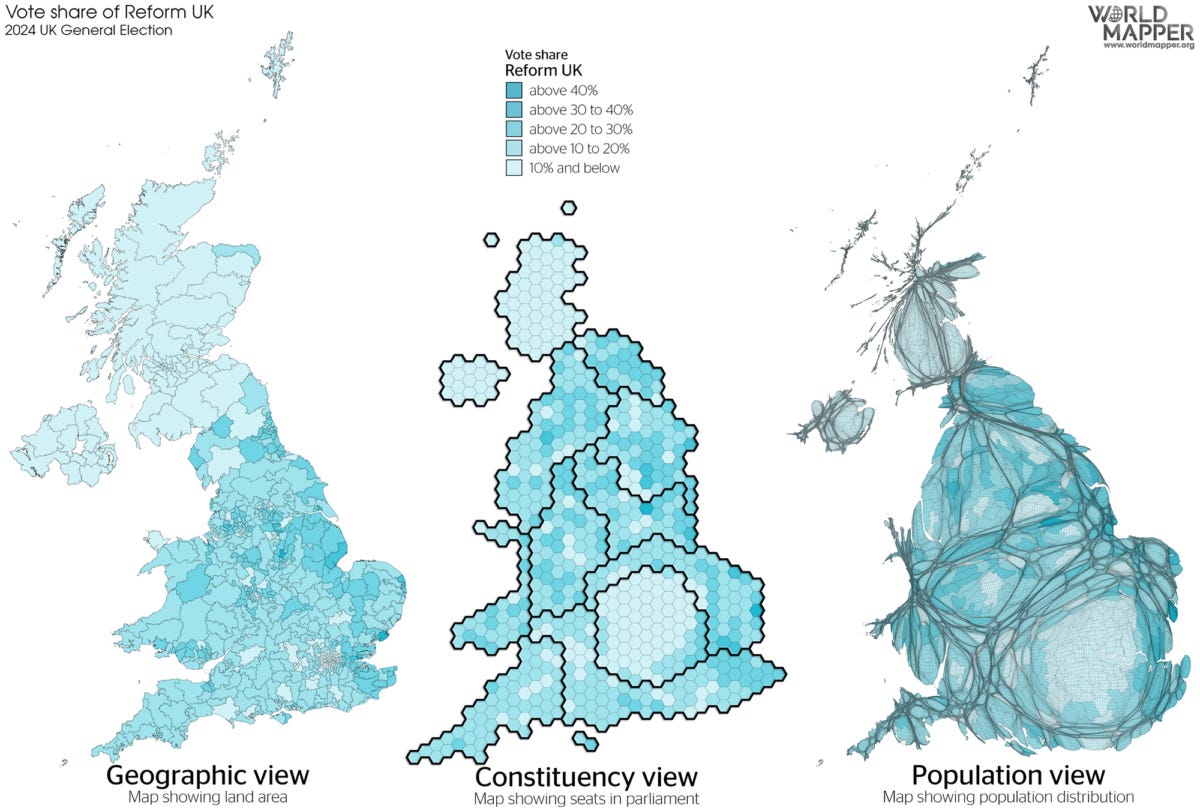
Finally, we come to Reform. I’ve mentioned them in passing throughout this piece, but Reform is the real “winner” of Britain’s political chaos. Nigel Farage’s latest vehicle in his long and winding quest to become Prime Minister has successfully discovered that a large pool of voters exists who want nothing more than less wokism and less migration.
As a result, the party has been surging in the polls, appearing to pull voters from both Labour and the Tories. The ultimate question in UK politics right now is whether Reform can sustain this rise—or whether their support ceiling is just high enough to appear commanding in an unstable four-party equilibrium.
Farage himself remains deeply unpopular—though, to be fair, so are all the current party leaders.
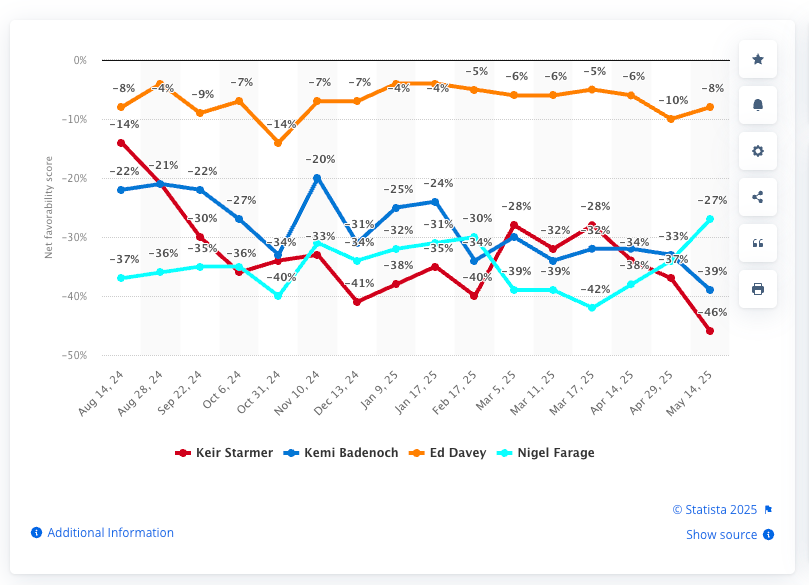
And Reform politicians have a tendency to engage with genuinely unsavory white identitarian circles on Xitter to a degree I suspect is unpalatable to the average Briton (although who really knows anymore). If Reform can hold itself together, I suspect they will eventually consume the Conservative Party and possibly win in 2029. But it seems equally likely they’ll implode into infighting and civil war before getting the chance to seriously challenge Labour.
Please consider becoming a paid subscriber. For $5/month or $30/year, you'll gain access to all my paywalled articles and earn a permanent spot in my heart.