Okay but seriously. Where are the millennial artists?
The (re)Birth of Tragedy
Summary: The essay argues that millennial artists have largely failed to achieve the cultural prominence of preceding generations despite being at comparable career stages, attributing this disparity to institutional artistic bankruptcy in mainstream media institutions. The author contends that a dominant artistic movement from the 1970s exhausted its creative possibilities while simultaneously creating disincentives for genuine innovation through fear of social cancellation. He suggests that this institutional constraint does not reflect a lack of generational talent, as millennials have thrived in less gatekept domains like music and digital content. The essay concludes by predicting an emerging counter-movement driven by sincere self-expression, analogous to Romanticism's rejection of Enlightenment constraints.
Have you ever noticed how few famous millennial artists there are? I can think of a ton of musicians — Taylor Swift, Rihanna, etc. But outside of music, who is there?
I asked Claude for the most “famous” millennial authors it gave me this.
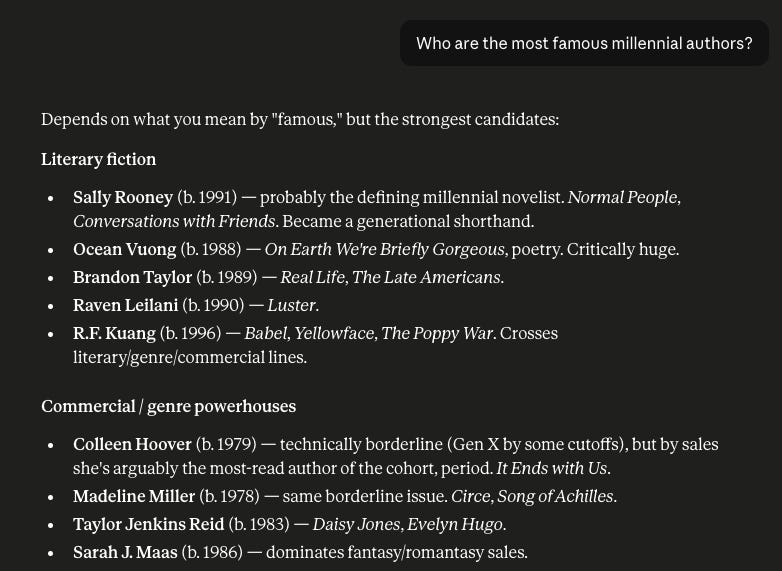
The only author I definitely recognize on this list is Colleen Hoover, since she writes quirky books. I believe I’ve also heard the name Sally Rooney before, but I couldn’t tell you a single theme she’s dealing with. Or even if they’re a girl.
Looking at directors, it is basically the same.
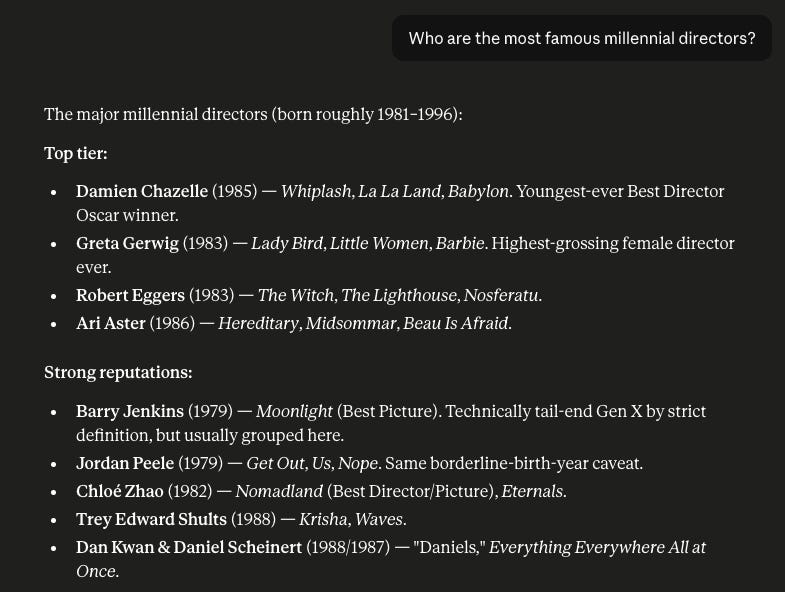
I enjoy Robert Eggers, The Northman is awesome, but it feels like a sorta niche. You could plausibly argue that Ari Aster, Joran Peele, and Greta Gerwig are household names. Still this feels like a pretty sparse list.
I’m not even going to pretend that I have any idea who a single millennial poet or painter is.
The goal here isn’t to millennial-bash, but it’s hard not to see this as a little remarkable. The oldest millennials, born in 1981, are now 45, so it isn’t like they, (we1), are even all that young anymore.
If we take the same point in the generational cycle, and ask what year the oldest Boomers and Xers were 45, you get 1991 and 2010 respectively. Looking at just directors and authors, since I have the most familiarity there:
By 1991 the Boomers already had:
Steven Spielberg, James Cameron, Oliver Stone, Spike Lee, Tim Burton, Ron Howard, Rob Reiner, John Hughes, and Joel and Ethan Coen. Along with Stephen King, Tom Clancy, John Grisham, and Amy Tan
By 2010 the Xers already had:
Christopher Nolan, Wes Anderson, Spike Jonze, Darren Aronofsky, Michael Bay, and Judd Apatow. Along with J.K. Rowling, Stephenie Meyer, John Green, and David Foster Wallace.
Since it isn’t like the genetics of our country really changed that much between 1965 and 1981, it is worth asking why it appears as if millennials basically don’t exist as the creators of our high culture.
My claim: the institutions are artistically bankrupt
It feels, to me, like our main culture-making institutions are artistically bankrupt, and have been accelerating toward prestige insolvency my entire life. The movies from big studios are boring. The books from big publishers are boring. Everything is sequels, spin-offs, and remakes. Whatever sentimentality does exist is almost always stolen from older material made in a simpler, more emotionally deep time.
Why?
I would argue that starting in maybe the 1970s, a “new school” of artistic thought became ascendant. Broadly it stood for two things: 1) an openness to aesthetic transgression, and 2) a basically coherent moral framework based on a synthesis of democratic socialist internationalism and liberalism.
Because this school came about by dismantling the previous artistic elite, it has proven itself remarkably resistant to reinvention. The very language that someone like myself would use to attack it is the language it defines itself with.
How can you demand more inclusivity from, say, Yale or USC when the problem is they care too much about inclusivity?
For a long time this school was very popular and produced many of the Gen X and Boomer artists I listed above. But by the 2010s we had basically run out of interesting things to say from this context. Not only that, but the information environment at this time was quickly changing due to social media. Suddenly, in a way that had not been true previously, transgressiveness — or even just the appearance of transgressiveness — would result in mass collective outrage and cancellation.
To compound this, the “type” of person who became an artist seems to have qualitatively changed after the 1960s. As celebrity culture — in particular musicians — exploded, there was more and more of a desire to “be” a celebrity, a priori to specifically how. People went into the arts not because they found them interesting, but because they were a path to a lucrative career. So now the writers of these movies, etc., are there because they won a meritocratic selection pipeline, which, like all employment, rewards careful, low-offensiveness reliability — not subversive or eccentric artistic modalities.
There are certainly even more incentives at play here, like the breakdown in the unified mass culture, or the decline of publishing, etc., but what really matters is that institutionally there has been little space for real progress.
A big part of the reason I think this has been so effective is that “censorship,” insofar as it exists at all, is both mostly about abstract taste and temporally asymmetric. People are very forgiving of old art and apply most of their scrutiny only to new material. Because artistic progress is, definitionally, a forward motion, a way of thinking that only binds the future while licensing infinite play with the past doesn’t suppress art as much as redirect it into pure aesthetic recombination. As a result, we have gotten maximal surface novelty (every transgression of form, style, shock) and zero directional change, because that would constitute progress — toward a new value, a value the scene doesn’t already hold — something which is largely foreclosed in prestige circles.
Another reason I’m convinced that the cause of this decline is ultimately institutional decay is that in areas where “raw” talent and creativity mostly define success millennials have succeeded as much, if not more, than previous generations. As I mentioned at the beginning, there are tons of millennial musicians but millennial also basically defined modern YouTube, people spend a LOT of time on.

I’m also looking to hit 100 paid subscribers, since I would very much like to get that orange check. So I’m going to attach a 90% discount here for everyone who wants to sign up. I’m going to be raising it substantially when I cross that threshold, so this is the cheapest it will ever be. Lock in an annual subscription for $5 now while you have the chance.
Behind the Paywall: What was lost & what comes next.
So what was actually lost?
What is lost is most of the human experience. We have some narrow “set” of established tropes that no longer matter to anyone. On my podcast with Prester John Andrews, yet to be published, he mentioned the televangelist character on The Boys as an example of this.
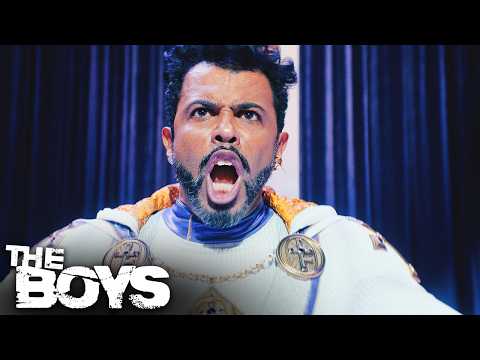
What is the year, still 1988? Is this still the Reagan administration? Obviously televangelists aren’t a major cultural force anymore. Why didn’t The Boys try to create an Asmongold character instead? At least that would have been temporarily relevant.
We have ink-blotted out huge parts of the lived, and dreamed, human experience!
But I think it’s coming back
The world is changing, and something is pushing and striving beneath the surface. Its exact edges are hard to define right now, but I can say this: people have an innate need to express themselves, and if the institutions which exist cannot provide it, others will.
Perhaps this change will be seen by the public while it unfolds, as the one in the 1960s and 1970s was; or perhaps it will go under the surface, only to be appreciated decades later when it has managed to break through. But I’m confident it is rising nonetheless.
Above all, what seems to be pushing against the thin earth rind of the culture is a volcano of sincerity. A volcano of affirmation and belief, analogous to the Romantic era’s rejection of the boxes imposed upon human thought by the Enlightenment.
Born 1997