No one would use California's train anyway
I would argue there are upsides to the way we currently do stuff.
Summary: Peter Banks argues that California's high-speed rail project would fail to attract significant ridership not due to construction delays, but because flying and driving already provide superior alternatives for most travelers. A comparative analysis shows flying is substantially cheaper (under $100 round-trip versus $170+ for the train) and roughly equivalent in total door-to-door time (approximately 4 hours each), undermining the train's viability. Banks contextualizes this within America's broader infrastructure preference for personal vehicles and aviation, suggesting the project serves primarily political rather than practical purposes.
In this article I’m going to make a simple claim:
It doesn’t “really” matter that California’s high-speed rail is such a boondoggle, because even if we could build it there would be almost no reason for anyone to ride the thing.

A hypothetical
Let’s say I had wanted to get from Palo Alto to LA while I still lived in the Bay. In this hypothetical universe the high-speed rail is finished and I’m choosing between taking it or flying. Here are the things I would weight.
Cost:
Flying wins by a country mile. Originally, the prices were announced to be $86 for a one way ride, but the price could be up to two times that according to some estimates. Let’s say an even $170 round trip. By contrast, an economy round trip from SFO to LAX, booked with any advance notice at all, routinely runs well under a hundred dollars. Hell there is an option right now going for $56.
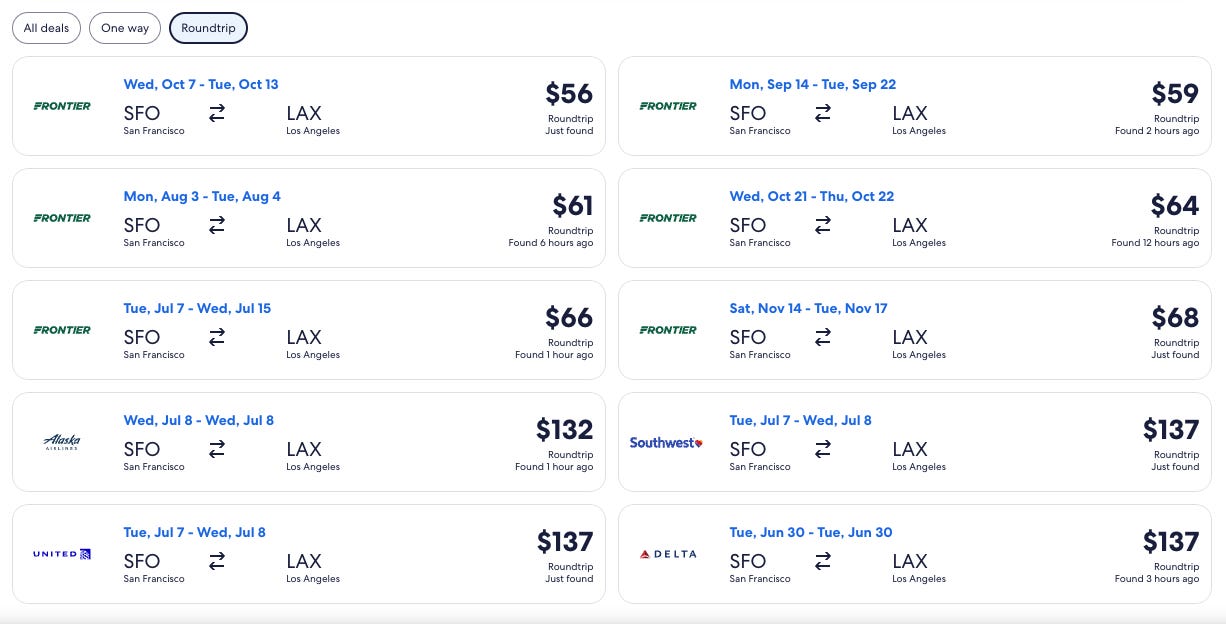
This isn’t even fair to flying because the train ticket price will ultimately be set not be economics as much as policy preference. It is extremely unlikely the route would be profitable and so how much riders are charged will mostly be up to how much Sacramento is willing to subsidize.
Time:
At best a wash. The state aims to cover the route between SF and LA in 2 hours and 40 minutes. With a 220 mph top speed, that works out to an average of ~135 mph meaning the train, which has to slow down and speed up, isn’t having to make routine stops. By contrast a flight from SFO to LAX would run you about 1 hour and 30 minutes. Gaming out the whole process.
Plane, Bay Area → LA:
Get to SFO: ~30 min
Recommended arrival before domestic departure: ~60 min
Flight gate-to-gate: ~90 min
Deplane and get out (no bag): ~20 min
Rental car or rideshare to actual destination: ~30–45 min
Total: ~4 hours
Train, SF → LA:
Get to SF station: ~30 min
Buffer before train: ~15 min
Ride: ~2.5 hr
Out of LA Union Station: ~10 min
Rental or rideshare to actual destination: ~30–45 min
Total: ~4 hours
All of this ignores the fact that the train would, compared to flying, doubtless run less frequently and so constrain my timing options.
Comfort:
The train undeniably comes out on top. Planes are small and, if I’m going to be honest, a little scary, whereas trains have much more space, etc.
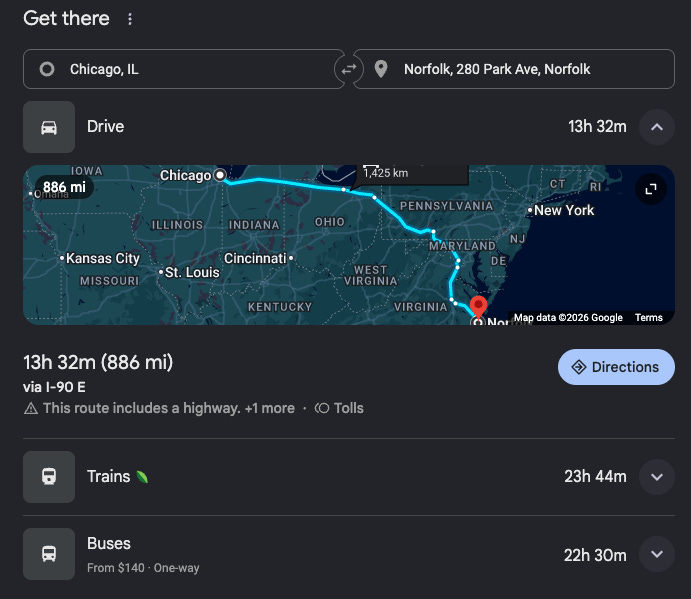
But the trade-off is never worth it, at least to me, because a train is still far more uncomfortable than my hotel room. In either case I’m suffering in a public chair on my iPad. Your mileage may vary, but when I think back on my 24-hour Amtrak ride from Chicago to Norfolk, what jumps out isn’t that the chair was nicer — it’s that the ride took 24 hours. (True Story)
And this isn’t just my idiosyncratic preference. The project’s own ridership forecasts have been collapsing from the start. Voters in 2008 were sold 95 million riders a year and now the most recent estimates are as low as 36 million by 2060. However, even these shrunken numbers strain my belief.
Taking a step back from this train in particular.
I feel like I’m able to speak on the woes of American urban planning more than most, because I got to live on both sides of the Atlantic growing up.
It is my sincere wish for America to develop a public transit system of the quality and type that exists in Switzerland. But it is a sincere wish in the same way I wish we would build our homes as beautifully as the nineteenth-century Swiss did — as opposed to whatever lunacy is taught in architecture schools these days.

Still, there are huge advantages to doing things the American way that people who either grew up here, or have never really lived here, will struggle to see.
In many ways, the U.S., culturally and civilizationally, is a little bit like those new-build construction units above. From the outside, we appear to be some horrifying amalgamation of mismatching colors and forms, but inside the actual house, things are much nicer than in any home I lived in in Europe.

People like to meme on Europoors for their lack of air conditioning, but issues like this are a perpetual problem that most Costco Americans simply cannot comprehend. Almost every modern U.S. home has a large freezer built into the fridge, a garbage disposal, central air and heat, often run off a touchscreen. Old, beautiful nineteenth-century buildings are honestly a pain to live inside for all their grace and density. When I lived in Hyde Park the apartments were often in stunning brownstones, but that came at the cost of the little perks you get from living inside a hideous rectangle.
I see a similar dynamic in urban planning. European transit is great in no small part because driving there is hellish — trying to navigate even suburban Geneva was often a nightmare. In the US we take the opposite approach and make driving as easy as possible. People generally prefer to drive when given the choice, which is exactly why dense, transit-oriented places only hold together where the state actively fights sprawl, as in Europe. Left to its own devices, as in much of America, development spreads out into huge asphalt shopping centers.
There are a ton of advantages to living in a dense environment with easy and safe public transit. And when I’m in cities like NYC or London, I’m struck by how simple, and how cheap, it is to get around.
But one way I would never describe public transit is fast or convenient.
If you live in a big city it simply takes fucking forever to get anywhere, and people there just accept it. When I visited London semi-recently and wanted to meet up with a friend from high school, it took me 45 minutes and something like two trains and a bus to get there. Riding transit is simply a slower, more frustrating experience, and it forecloses a lot of the options you have with a car — just as everyone ought to observe that suburbs foreclose options too. When I’ve lived without a car I’ve found myself tightly constrained by what’s within my immediate access; anything beyond that isn’t so much out of reach as functionally non-existent.
Coming back to the train.
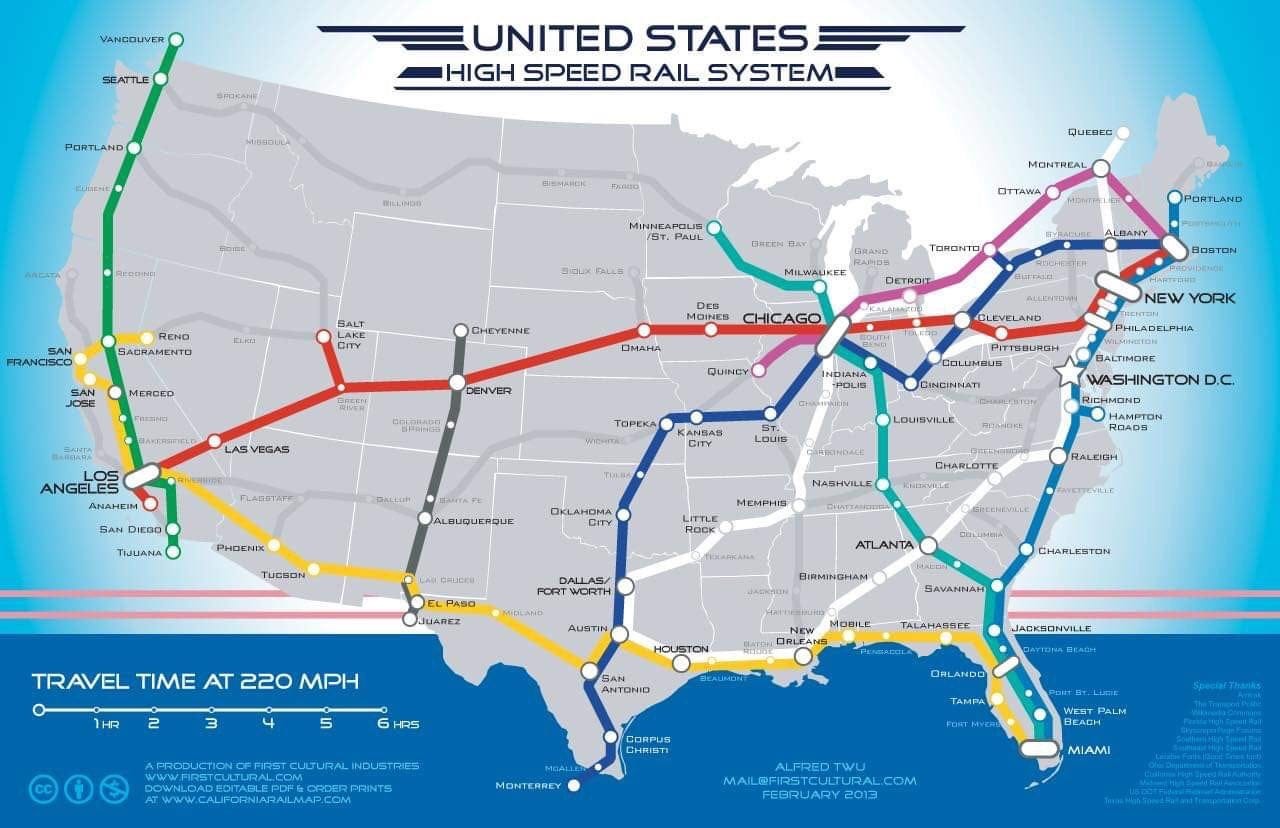
I’ve complained a lot about how expensive and slow the construction has been, but the much larger problem is the broader human geography of California, which the train simply wouldn’t solve. You can imagine a world where the entire U.S. population pattern is different and this route would be enormously useful; and in a way, by building it, California is paying tribute to that vision. But it isn’t the world the train would actually exist in.
Now, normally when someone admits this, they shake their head in somber disappointment at American foolishness and hope for a “better” world where everyone would prefer to ride the train.
But I disagree. Flying is awesome!
In the years after WWII, while the US was at the height of its economic boom, we built out a huge network of highways and airports that has no parallel in Europe. Almost every small US city has its own international terminal, and many big US cities have multiple world-class airports — DC, for example, has three, depending on which side you want to come in from. It is a sign of how amazing our infrastructure actually is that a hypothetical high-speed train would probably lose out to our pre-existing stack. The options available to Americans for a low cost — driving and flying — are the premium forms of travel for almost everyone else in the world. It would be unusual, for example, for a European to prefer taking a train, versus flying, from Madrid to Berlin if money were no object.
To summarize:
The train would be a fun thing for California to have, a sort of souvenir to show its dedication to climate and transit. But it would not meaningfully improve many people’s lives, and it would serve only a limited substantive function.
Because it serves little real purpose, it makes little real progress. I increasingly think no one involved even takes the project seriously — and why would they? The objective isn’t to provide a public service; it is to create political capital and win votes. If people really needed the train, it would have been finished in a heartbeat, the legal barriers in its way thrown aside. But since a “better” option already moves thousands of people a day, it’s hard to get worked up.
I’m also looking to hit 100 paid subscribers, since I would very much like to get that orange check. So I’m going to attach a 90% discount here for everyone who wants to sign up. I’m going to be raising it substantially when I cross that threshold, so this is the cheapest it will ever be. Lock in an annual subscription for $5 now while you have the chance.