My ranking of US Presidents
proof I'm not audience captured
Summary: Peter Banks ranks US presidents from 1789 to the present using a tier system (S through F), asking how history would have changed if each president didn't exist. He organizes presidents into ten eras, emphasizing how presidential impact depends on their era's demands, their character, and their ability to inspire the nation. The essay argues that effective presidents—whether Washington, Lincoln, or FDR—fundamentally reshaped American society by aligning their leadership with the needs and capabilities of their time.
Now that I have finished querying the community for their ranking of US Presidents, and can optimally pander to my audience, it is my turn to judge them all.
I’m going to warn you before we set sail: this will be a perilous and somewhat dubious journey, made all the worse by the merciless gunfire of my opinion. It will also be a long article so buckle in.
If all you wanted was the tier list here you go:
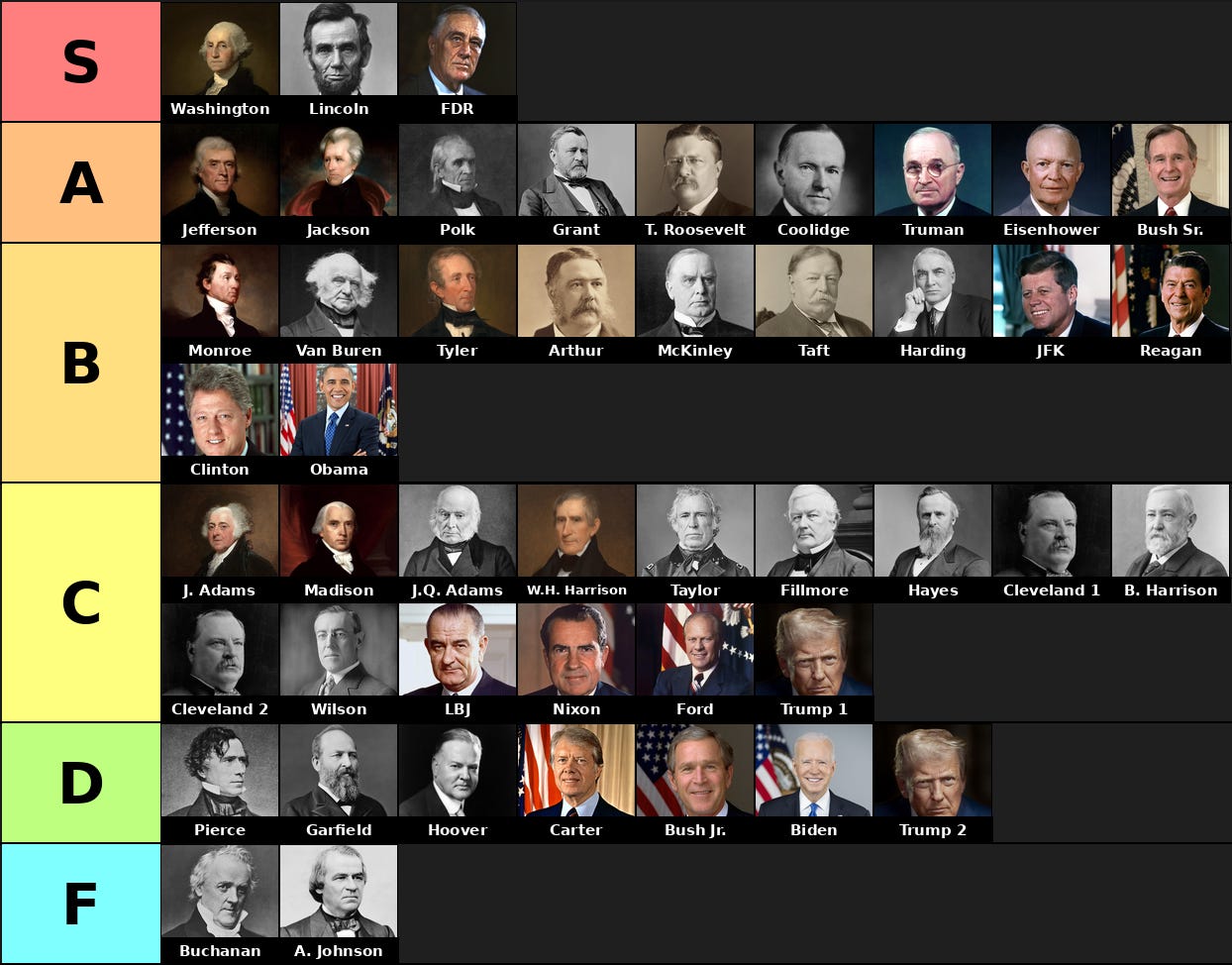
Now please explain why I am wrong, politely, in detail
How to rank them…
When we rank a President, what are we supposed to be assessing, exactly? Are we judging their souls — their inner nature and aspirations? Or are we supposed to assess them by asking how they would do, today, if teleported forward into our current moment? Even once we settle how we’re measuring, we have only opened another enormous can of worms around the definition of what we are supposed to be measuring exactly.
Nevertheless, the way I like to think about assessing Presidents is by asking how history would have changed if, for some reason, they had not existed. One way to think about this is the premise of It’s a Wonderful Life. For those of you who didn’t grow up in Anglo-American culture: in this movie the main character, George Bailey, a small-town banker, is on the verge of personal and professional failure. In his final moment of desperation he goes to a bridge in preparation to kill himself. Right before he jumps, an angel appears and offers to show him what the world would have been like without him.
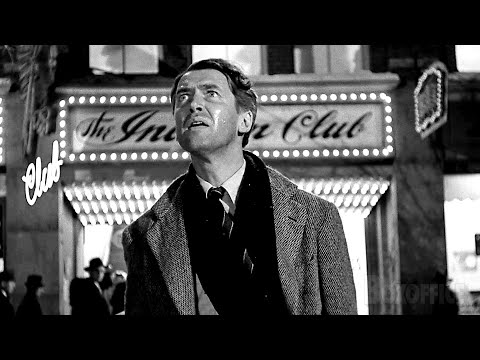
Bailey is then transported back to his town, Bedford Falls, where he is shown a substantially worse world. It’s a great movie and I won’t get too deeply into the plot — if you are looking for something this Christmas, I recommend it — but I love this idea. Would the world be a better, or a worse, place if the person didn’t exist? Inevitably since we cannot directly access causality we are left with the pitfall-strewn tools of observation and conjecture. Aka this is all my opinion.
I’ve graded them on the indigenous Anglo method of the “tier-list.” Here we assign each president a grade between S and F. C implies the president was indistinguishable from replacement, or otherwise comupperplex enough to cancel themselves out.
As for the problem of goodness. What America has meant, and the ways in which it has evolved, is in many ways the history of our country. In as much as it was possible I’ve tried to assess them for how they benefitted ~America~ as they themselves would have seen it.
Now onto the list! I have structured this article into groups by era.
Era 1: The Patricians
Let us begin at the beginning. The Republic of 1789 was built around the principle of deference to a small, propertied electorate, or moral and economic merit. In practice this looked mostly like an enshrinement of power around the revolutionary generation — officer-planters and lawyer-merchants who had won independence and expected, not unreasonably, to administer it. Since faction was considered a disease of republics that the founders were keen to avoid, politics was the internal deliberation of a patriciate, conducted, largely, with honor and dignity. The office of president itself, as with all of our political institutions, was only loosely defined, and it was in the hands of these early founders that they took the shape we have now come to know and expect. What is remarkable, to me, is that they only vaguely understood the significance of what they were doing at the time. Rather than utopian dreams about the modern world we all inhabit, they were dealing with the extremely practical problem of how best to govern a society transplanted onto a new world — with, from the perspective of the people at the time, a genuinely endless frontier stretching out, waiting to be conquered. Everyone knew on some level it would be conquered, peopled, filled up, and that in this place a new society was going to emerge — that they were founders in the tradition of Aeneas in ancient Rome.
George Washington — S
In every nation there is a tendency to rank the “father of the nation” very highly, irrespective of whether he was a good ruler or not — across Latin America you can see this with Bolívar, whose project was shattered, and yet he continues to hold great cultural prestige. In America’s case the association is well deserved, by the tremendous success of the project and by the maturity of the men who built it. Washington stands above the other Presidents in a simpler sense too. As I said earlier, so much of what we think of as the President — the whole ethos around the office — was established by him, and it’s extraordinarily difficult to overstate the importance of that. Everyone in America of my generation heard the story of Washington and the cherry tree — “I cannot tell a lie” — and while the story itself is a whole-cloth invention of Parson Weems, the myth stuck because the character it was attached to could plausibly carry it. It’s hard to call him a morally virtuous man, exactly — he was not above duplicity and he was not above cruelty, so it depends on how you want to define these things — but regardless, he was a very upright man.
If he had been replaced with a random person who was more factional or more divisive, America could plausibly have gone down a much darker path.
John Adams — C
Adams is the second and last president in this tradition. And in him you begin to see its darker aspects, the elitist, anti-democratic impulse that thinks it knows better than the population. He was, at heart, an aristocrat ruling over a people he believed didn’t know what he knew. Perhaps he was right, but this feeling was behind actions such as the Alien and Sedition Acts, and his habit of generally being kind of a dick.
That being said, his actual presidency was fine — he didn’t catastrophically mishandle things. Even if I believe the Federalists were largely wrong about the problems our country was facing, he was far from bad. Middle of C tier.
Era 2: The Jeffersonian Settlement
One of the most aggravating limitations of the British colonial government had been its restrictions on frontier settlement west of the Appalachians. For complex reasons — disease, Iroquois conquest, war with the British and later the Americans — the lower Midwest in particular had been massively depopulated. After victory in the revolution, this land was opened up to smallholder farmers, who exploded into the “empty” country. The result was a large cohort of middle-class smallholder farmers who were qualified to vote but who didn’t share the political instincts of the urban and educated Federalists.
Even so, there was, largely, a feeling of deference to the revolutionary-era patrician class which had “won” the nation’s independence — and the land these farmers now tilled. This is the final era of American politics best understood as analogous to the pre-industrial civilizations of Eurasia.
Out of this economic rebalancing toward democracy, and elite maintenance of federal power, came what I like to think of as the Jeffersonian Settlement. The Presidents of this era were only vaguely aware of how different their era was. They considered contemporary British and American society to be on a continuum with ancient Rome — both pinnacles, both profound achievements of human and societal engineering, but both achievements within the framework of history’s regular vacillations of rises and falls.
Thomas Jefferson — A
Jefferson represents two things in the American project that were very positive. First, geographic expansion — the beginning of Manifest Destiny, set in motion by the Louisiana Purchase doubling the size of the United States. And second, the democratic, anti-elitist one.
In many ways he perfectly represented the age. He was himself an aristocratic planter and a slave owner, who probably never worked a real day of manual labor in his life. He was also the author of a whole slate of legislation designed around securing the existence of a robust plebeian farmer class. His view that American democracy could only be sustained by self-sufficient citizens was close to objectively true in the pre-modern environment he operated in. Had we instead gotten a commercial aristocracy, we would have inevitably slid into plutocracy and oligarchy. Even if all of America had been settled like the South, in the pattern of aristocratic plantations, we would have developed nationally for the worse. Jefferson pushed hard in the direction of policies which allowed American democracy to survive.
What keeps him from S tier is that I do not think he was indispensable, as is the case for, say, Washington. There were many other men in the wings arguing the same policy with similar pedigrees — Madison, Monroe, Gallatin, the whole Virginia bench behind them. Similarly, although the purchase of Louisiana gave the conquest a legality which I credit Jefferson for, its conquest only required the removal of a restrictive hand on westward settlement.
James Madison — C
Madison’s greatness was almost entirely related to his pre-presidential career, The Constitution, Bill of Rights, and the Federalist Papers to name a few. But we are ranking presidencies.
At this job he was unremarkable and mostly defined by the War of 1812 — a war that was all but inevitable, and that he steered to stalemate. On the good side of the ledger, Tecumseh’s confederacy was broken and the British had abandoned their designs on the Northwest. Additionally, we won something nearly as valuable, British respect. On the bad side, we failed to conquer Canada and our capital burned while the government fled into the countryside.
And yet the Republic survived its first real stress test. Madison also deserves credit for what he did not do, such as new Sedition Acts or suspended elections.
James Monroe — B
Monroe is the last of the Revolutionary officer-statesmen to hold the office, and thus the final president for whom the Jeffersonian Settlement functioned smoothly. His presidency was successful with the acquisition of Florida and the establishment of our self-conceived role as defender of the former colonial settler republics.
What keeps him out of A is that he was truly a creature of his time. Although he was capable, there is little to make me think he himself was, personally, indispensable to the era.
John Quincy Adams — C
JQA is the last man trying to hold together a political compromise that is already dead, which makes him hard to judge. On the one hand, he was substantially correct in all of his criticism of Jackson and the Jacksonians more generally. But on the other, what would victory have even looked like for him? The perpetual political disenfranchisement of the western states and the frontier population? That was demographically, economically, and politically impossible to sustain.
The famous “corrupt bargain“ is the perfect miniature of his predicament. How do you define corruption? Did it break any rules? No. Did it break the spirit of the election? Yes. JQA was an extremely competent and qualified man who would have made a fine president only one election earlier, but who was blind to the calling of his time.
Era 3: The Jacksonian Relitigation
American society had failed to become fully democratic — power had consolidated in the hands of a relatively small group of politically connected people — and this era is the natural reaction against that. Democracy is messy this way. Historically your real options are an oligarchic aristocracy or a powerful executive; there are, as always, counterexamples, but that is the default, and expansions of popular power almost never come from a committee — they come through some Caesarean figure who battles the establishment. America was largely a frontier country, and it did not make sense for East Coast plutocratic merchant elites to rule a nation that was agrarian, rural, and frontier. If Jefferson moved the dial of fundamental economics toward the smallholder farmer, this era is that economic reality finally brought to politics.
What makes the era so difficult to grade is that in nearly every one of its great fights, both sides were entirely correct. The coastal patricians were more morally upright and less corrupt, and Jacksonian rule was chaotic and violent. But the patricians also supported an economic and political policy that would have left America weaker — little more than a string of cities along the Atlantic — while the Jacksonians, whatever their methods, were pro-expansion, pro-small-farmer, and pro-democratic institutions.
Andrew Jackson — A
Although, as people are fond of pointing out, Jackson was not so much the cause as the symptom of democratization, he was a political force in American society and the physical type of the age itself — Scots-Irish, frontier, dueling — in a way no Boston merchant could ever be. Jackson is what it looks like if the Gracchi had won.
“Embodiment,” can easily shade into “replaceable,” and I reject this as a modern invention. To everyone alive at the time, it was obvious that Jackson was the cause — or if not the sole cause, then through his energy and skill the architect of the era. Even his opponents, in their fear of him, saw it exactly this way.
A universe without Andrew Jackson is a universe where America is a much weaker country. It was impossible for the mercantile East Coast republic to hold together an exploding settler population without changing itself. Meaning either the settlement would have been stopped or America beyond the Mississippi would have become some quasi-independent clusterfuck. The assertion of the farmer and smallholder over the merchant elite is, from where I sit, net positive — mixed, as it always is, with the tendency toward the monarchic that comes free with every Caesarean figure.
Additionally, facing down South Carolina over nullification was vital to the survival of America. The Bank War was stupid and obviously economically counterproductive — and yet the Bank was genuinely captured, meaning as with the corrupt bargain, both sides were entirely correct.
Finally, there is Indian Removal. Jackson understood the policy as the only way of “saving” the southeastern nations from the fate of the midwestern ones — wiped out piecemeal by settlers and federal troops — and he was substantially correct that the removed nations were permitted a self-rule granted to no other native group east of the Mississippi. It was also viewed as wrong even at the time, and the honest defense is not that it was good but that the realistic alternative was Washington turning a blind eye while the settlers finished what they had started everywhere else.
What keeps Jackson from S to me is that he was in many ways shaped by a natural symmetry to the patrician class he battled with. This entailed the rejection of many virtues they exemplified, temperance, wisdom, farsightedness, just as it entailed a rejection of their vices.
Martin Van Buren — B
Continuity of the Jacksonian policy by the Little Magician. The Panic of 1837 detonated on his watch, but it was the result of Jackson’s destruction of the dollar economy. Where I feel I part from most people here is that this was always the goal of Jacksonian policy. Since the idea was to benefit the small self-sustaining farmer, that meant horrible macroeconomic conditions for what merchants and creditors called “the economy.” But for most people — cash-poor, self-provisioning, on the land — it was of little note.
He, like Jackson, is boosted by my directional agreement with their policy on expansion and the importance of the plebs.
William Henry Harrison — C
Thirty-one days in office. No idea how to judge him. Literally replacement level.
John Tyler — B
Tyler represents the purest symbol of Jacksonian cultural victory. Although a Whig, he was unrecognizable next to people like JQA.
He gets credit for Texan annexation — signed three days before he left office — and for simply seizing the full office on Harrison’s death, which set the precedent for every succession since. I would argue that Martin Van Buren would have made a worse President, which puts him above replacement.
James K. Polk — A
The last true frontier President, and the culmination of the whole Jacksonian trajectory of military expansion. There isn’t much to say about him beyond this, since his presidency was defined more than anything by conquest and expansion — from the finalization of Texas’s annexation to the conquest of the Mexican Cession, and the settlement of the Oregon Territory with the British. He did an incredible job.
Era 4: The Compromise
With the finalization of the western conquest, the question of how to allocate the enormous spoils became the primary debate in American society. Broadly, the fault line more and more came to run through the question of slavery and if it was to be extended into these new lands. By this time a delicate arrangement, somewhat accidental and then increasingly deliberate, had left slave and free states with an equal number of senators, leading to true legislative deadlock.
While this was occurring, the North was pulling ahead demographically and economically on the back of immigration and free labor. The most explosive book of the 1850s, Hinton Rowan Helper‘s The Impending Crisis of the South (1857), was an accounting of how slavery had impoverished the South’s own non-slaveholding White majority. It is worth realizing, though, that even if the North was pulling ahead, both Yankee and Dixie societies were extraordinarily dynamic and expansive.
All the same, preserving the political balance between them necessitated preserving and extending slavery, and that was unacceptable to the North on three grounds. Morally, as an abomination. Economically, as the fear of the Slave Power. And demographically due to a desire to keep America White. It is this last item which was probably the most widely popular at the time because it viewed the new land as the patrimony of the White smallholder. Even among many Southerners there was a view that slavery implied the “pollution” of America’s racial purity, to the benefit of a small clique of planters.
It is hard to judge the presidents of this era because our assumptions are both so similar and so different. The American slave system was a moral crime, and so abolishing it was extremely important, but how it was to be done, and what a post-slave society in the South would look like, were questions no one had good answers to. Gradually, as the pressure from abolitionists in the North heated up, the South began to feel itself as under attack and at risk of being turned into a dominated region. There were doubtless paths through this era which could have arrived at emancipation without a Civil War, but I doubt anyone today would do much better. Everyone at this point was aware that the “future” would be won by whoever got control of the West, and neither side was willing to lose out on that.
Zachary Taylor — C
A weird President. A soldier with no political past, a Southern slaveholder President who threatened to hang secessionists and mostly opposed expansion of the institution. It is possible that an earlier confrontation under him would have forced the issue and saved thousands of lives, or it could have shattered the Union then and there. Average.
Millard Fillmore — C
Signed the 1850 package Taylor resisted and bought the decade its false peace. Neither catastrophically bad nor wonderfully good, he faithfully executed the presidency, and I see no reason to believe anyone else would have done the job better.
Franklin Pierce — D
Kansas–Nebraska is the end of the false peace because it opens up the question of expansion to the pure forces of demography. A replacement Democrat does not necessarily detonate the Missouri Compromise, and that probably poured fuel onto the flames. To the Southern population it seemed to indicate that abolitionists were willing to celebrate the murder of innocent civilians, and to the North it seemed to vindicate the existence of the Slave Power and its desire to creep into every corner of the West.
James Buchanan — F
It’s a little unfair to hold Buchanan to a separate standard from Pierce — he is simply the President who catches the hot potato. Everyone had been trying to balance a political compromise that was becoming economically and demographically unbalanced, and Buchanan is the last man trying to hold together an arrangement that is obviously dead.
Even so, he deserves the F for the simple reason that his moment demanded action and he gave essentially none. What little he did do merely inflamed the North, which already felt cheated. For example, pressuring the Court toward Dred Scott, or trying to ram the Lecompton fraud through Congress against the actual majority in Kansas. A better president may have still avoided catastrophe, but alas.
Era 5: Lincoln, Reconstruction, and the Caretakers
Between Jackson’s rise to power and the election of Lincoln, a long, slow simmer had been heating up into a full-on boil. Among the Southern white population, terror at the prospect of a general slave uprising, funded and abetted by Northern abolitionists, was running hot. And in the North, resentment at a political system which was denying them the control their demographic majority seemed to entitle them to had reached a high point. Something had to break, and when the presidency, and with it control over the coercive power of the state, finally fell into the hands of an out-and-out abolitionist, the dam broke.
Now the North was going to abolish slavery irrespective of the desires of the South, and they could do it without earning a single Southern vote.
Most of you know the history of the war, but what I personally find miraculous about this era is that we were mostly able to put ourselves back together again. It should not be taken for granted that the Civil War did not reignite; that is historically the default. Especially since Reconstruction was hardly a stable, clear-minded basket of policy, and to this I mostly credit the silent presidents of the second half of this era. America devoted itself to becoming rich, and it did that with an excellency which has arguably never been matched.
Abraham Lincoln — S
I do not think a world where Lincoln is somehow absent arrives in a materially different 1860. The question is thus really “which” Republican was going to be at the helm when the South broke away, and Lincoln did an extraordinary job.
Obviously he was not perfect, and there is no end to his list of failures if you go digging, but he was a President desperately trying to hold a Union together while fighting what he correctly saw as a moral abomination. What carries the S, though, is the man himself, and the way his character reflected onto the era.
Like Jackson, Lincoln was a uniquely capable man and the people of his time saw it — even his foes. However, unlike Jackson, Lincoln was also a fundamentally wise and honorable man who exemplified the best of the plebeian — Marx called him “the single-minded son of the working class” — and the Federalist thinker.
Andrew Johnson — F
Similar to Buchanan, it is a little hard to judge Johnson. The crime that is most often leveled at him - his light hand on Reconstruction - is, in my opinion, unfair. Johnson’s policies were substantially a continuity of Lincoln’s, much as people like to debate it. What differed between the men was their ability to act upon it.
Lincoln had the prestige and popularity to hold the line, but Johnson, who wasn’t even a Republican, merely inflamed the Northern Republicans more. What arrived was the worst form of Reconstruction. First, slavery was reimposed in all but name, and the Confederate planter elite was put back on top. Before the legislature reasserted itself and began to run a much more ‘radical‘ line.
What we got thus was a stew of maximum resentment and minimum progress. The cleanest replacement test here is Hannibal Hamlin, the sitting Vice President who was swapped out for Johnson in 1864. Keep Hamlin, and Reconstruction has a stable, if uncertain, flavor.
Ulysses S. Grant — A
Grant was a strong President at a time when we needed one. Where Johnson lacked the ability to implement his own policy, or the temperament to go along with Congress, Grant was able to use his immense popularity to set the tempo himself. He was a fundamentally fair and even-minded, morally upright individual, even if this was tainted by a leniency toward corruption in his inner circle — and a lifelong reputation for drink.
The real problem he faced was that the South had been defeated but not crushed. Its losses were staggering, and yet well over a million military-age white Southern men had survived the war, and more importantly a whole generation of new men were already being born. Clearly a federal occupation could not be maintained forever, but at the same time the rights of the freedmen needed to be protected. Grant was walking a fine line here, and he did the best he could with the options ahead of him. I can think of no one who would have done a better job.
Rutherford B. Hayes — C
I’m still unclear on if the Compromise of 1877 is even a real thing. What does matter is that under Hayes, Reconstruction functionally ended. It was bound to end anyway, and his presidency was serviceable. He is also the first of the invisible presidents. The ones I’m not even going to pretend to know well.
James A. Garfield — D
Two hundred days, eighty of them dying.
Chester A. Arthur — B
Famously, the machine spoilsman who turned against his own tribe and signed the Pendleton Act. He was a good president, all things considered.
Grover Cleveland (1st) — C
A fine administrator. Also fat.
Benjamin Harrison — C
On paper a busy president, in reality replacement level.
Grover Cleveland (2nd) — C
Still unremarkable. Still fat.
Era 6: The Progressive Phase-Shift
Under McKinley, the presidency undergoes another change — the beginning of the progressive movement in federal politics for real. This one is different from the reconstitutions under Jackson or Lincoln in that it wasn’t caused by an imbalance between the political system and the forces of economics — if anything, the Northeast and Midwest were more dominant than ever — but instead because of a general belief that things could simply be done better.
Everything was in a state of reimagining and rationalization. Look at science itself: in the 1840s and ‘50s it’s a slapdash affair, somebody in a lab doing Frankenstein shit; by the late 1890s it has been formalized and institutionalized, and the progressive movement is the political twin of that transformation.
Taken as a whole, the project was a good one. From 1896 to 1920, America underwent incredible growth, cleaned up its slums, and removed much of its corruption and pollution — in short, enormous progress was made along almost every dimension of our lives. The output of this era is almost unnamable; it is so huge. One exception to the general positive bent of this movement was racial justice. It was during this time that America reached the nadir of its race relations. After Reconstruction, racial equality had become associated in the public mind with corruption and degeneracy, which itself must be purified and removed.
On policy these presidents can be treated as one big blob; what separates them is mostly their vibes, but that is beginning to matter a lot.
William McKinley — B
He represents the beginning of self-awareness in America of our new status as a global power, a Great Power (proper noun). Our vacillations between reluctant and enthusiastic jostling for the role of world imperator will define the rest of this series. McKinley is overshadowed by his successors, but his conquest of the Philippines earned America global respect and whetted the appetite for empire.
Theodore Roosevelt — A
Teddy has the best aesthetics of the blob by a country mile. He is also the first man to realize the power of the president to change not just American law but also our culture and society directly. In this, he was the first President to master the daily papers, the first to make the White House a stage, and also the first to make his presidency one of relentless meddling in the private economy.
It would belittle him to say that any progressive would have governed the same, although it is true, because Teddy changed the national tempo. He set loose a collection of forces which invigorated the entire era, and for that we credit him with every good result.
William Howard Taft — B
Policy-wise a near perfect continuity with Teddy, arguably the substance actually accelerated under him. But he lacked Roosevelt’s charisma and paid the price for it. What raises him from pure replacement is that Taft lacked the authoritarian instinct that both his predecessor and his successor had, and which ran hot in the 19th-century progressive movement.
Woodrow Wilson — C
If Teddy has the best vibes of the bunch, then Wilson has the worst. I’ve already written about why I think Wilson is overhated here, but the short answer is where we assign him all the bad parts of the progressive era. This is because Wilson was both a utopian liberal and an out-and-out white supremacist.
Although he didn’t mandate resegregation, he did nothing when his cabinet did, such as Burleson at the Post Office and McAdoo at Treasury. That said, Wilson sat in the middle of the spectrum of his political time, far from its radicals and deeply at home with moderates of either party.
What he does own is the US’s involvement in WW1 and his dream of international cooperation. It took FDR and the victory of the US in WW2 to actually implement his plans as concrete policy, but without his presidency, it is quite plausible no one would have championed them on the international stage. Because WW1 was such a closely fought affair, the question of if and when the US should have entered is one which has long been discussed. Wilson did his best to avoid our entry into the war, and Germany effectively forced our hand with the resumption of unrestricted submarine warfare and the Zimmermann Telegram. Both Teddy and Taft would probably have joined the war much sooner, but it should be understood that to both of them the goal would have been propping up the Anglo empire, and possibly participating in the spoils — not a high-minded crusade for democracy. That is Wilson’s creation.
And so, on net, I believe he was average. It is hard to say he didn’t shape the trajectory of our history, and because I’m broadly happy with the modern world system, he deserves serious credit for that. But his presidency was also pocked with failures aplenty.
Era 7: Reaction, Crash, and the Vibe-Setter Presidency
Underneath the politics of the twenties, something is happening to culture itself that would change what the presidency was. For most of human history, there existed two distinct cultural spheres. A geographically expansive elite culture, gated by the ability to read the prestige language or even just physically get books, and beneath it a particular culture — the legends and heroes of your own town and your own province. From the printing press onward, the bar for inclusion in the elite sphere had continuously fallen, broadening (and arguably cheapening) it, until the advent of the radio. With this, suddenly, culture was ~homogenized~ on a level never before seen.
What emerges in the 20th century, through the radio and the movie theater, is a collective mass participated in by everyone, elite or not.
You have to understand what this felt like to a person living through it. Suddenly, for the first time in human history, you could all “listen” to the spoken words of the same person. I love the example of Father Coughlin, a Catholic priest with a famous radio show. At his peak, an estimated thirty million Americans, or about ¼ of the country, tuned in to his Sunday afternoon service. In the immigrant neighborhoods of the industrial Midwest, you could walk the length of a block and never lose the broadcast, his voice pouring from every open window in turn. Wallace Stegner described it as “a voice made for promises.” Of course Coughlin is no longer well known because he spent the 1930s moving rapidly from “Roosevelt or Ruin” to raving about Jewish bankers, until the Catholic Church formally silenced him.
I’m giving this example because there was a vacuum waiting to be filled. People were clamoring for someone to tell them what to think, and they were turning every which way to anyone who would make them promises. Because the President wields the coercive power of the state, and we have no real religious leaders or cultural leaders in the US, he is the apex force of American society. It was inevitable that the role would be transformed into the conductor of the national mood, and this meant vibes were the rule of the day. Even if you implemented the best possible policies, if everybody thought you were a good-for-nothing, the whole country could still go down in ruin.
Warren G. Harding — B
A mature form of political reaction that was progressive in method and convinced the government had gone too far: too much consolidation, too much centralization, too much racism. His Birmingham speech openly advocated Black political equality in 1921, and the Dyer anti-lynching bill passed the House on his watch. Teapot Dome is what he is well known for, but he was on the whole a good president.
Calvin Coolidge — A
Coolidge is the unsung hero of the 1920s. Under him, the second civil rights movement took root, American society improved across the board, and his policy of economic liberalism led to broad-based growth.
His most important piece of legislation was the 1924 immigration restriction and, although my audience no doubt in large part disagrees, it was a necessary law. At this point, the US industrial cities were heterogeneous collections of workers sharing little in the way of nationhood and riven with incalculable grievances. By closing the door, the US got a generation to cook with no new arrivals stirring the pot before FDR, which allowed us to forge a dominant, homogeneous, and by all respects very good, national culture.
Herbert Hoover — D
Anyone who is telling you they know exactly why the Depression happened is lying to you, or deeply confused. Truthfully, we will never know the precise causes of it, but the simplest explanation is that we never put the pre-WW1 system back together again. Prior to the Great War, the international system had been burdened by relatively few rules on the flow of goods, labor, and capital. This obviously changed with the war, and even after fighting had stopped, it gave the Great Powers pause at the prospect of allowing vital national industries to be built up in their possible enemies.
None of this was under the control of Hoover, and his responses were roughly in line with what an average person would have done. Where he fell short is in his ability to inspire hope in the American public. Americans were yearning for something to hold onto, some cause through which they could sanctify this suffering into necessary cost. Hoover lacked the ability to sell a vision, if he even had one, which left the entire nation jerking around in the dark.
Franklin D. Roosevelt — S
FDR is the father of modern America and the American empire. It is his personal creation, and without him it would have been substantially and aesthetically unrecognizable. Although this in part looked like dramatic legislative changes, more than anything FDR’s primary accomplishment was aesthetic. He changed what people thought the government’s responsibility was, what people inside the government thought their own role was, and what we even thought the purpose of this country was.
His specific personal background, the pampered heir of a political dynasty, gave him an unending self-confidence which was exactly what the country needed at the time. His insatiable sunny optimism flavors the entire New Deal and the 1940s more generally, and I believe is at least partially responsible for unleashing the productive forces of the US at the outset of war.
If you replace him with some regular Republican of the era, I simply don’t believe that man welds and reforges this nation of disparate, grudge-bearing groups — Anglos, Catholics, Jews, Orthodox, packed into industrial cities — the way the New Deal coalition did. Nor do I think that they would have been able to put together the postwar system in the way he did. FDR was the pinnacle of the Progressive era and the ruling WASP aristocracy, and because of this he was given enormous sympathy by the press, academia, every prestigious institution — including the South, through his status as a Democrat. It was this synchronicity with the real power centers of society that made his presidency so effective.
I’m not going to pretend that FDR was perfect, nor that his policies have even held up all that well to history. But it is undeniable that the empire he built has been the most effective, most powerful, and wealthiest the earth has ever seen. There was a psychic vacuum of the size of the presidency that was going to be filled by something. All across the world it was being filled by uniformed men on balconies, and FDR was a good something. The hypnotic collectivist frenzy we got in the United States was, all things considered, spectacular: as good as one of those could possibly have looked.
To cap it off, we never had to face the music of dictatorship. FDR’s death turned him into another Cincinnatus, whatever his private desires may have been.
Harry S. Truman — A
Truman is a chronically underrated president in my opinion. Much of what he did is lumped into the FDR presidency because his contribution was the finalization of the form. Analogy can be dangerous, but there is something vaguely Tiberian in Truman. He was a dour man with few friends, and yet a competent administrator who saw the problems of his time and faced them.
His use of atomic weapons was defensible, although people can disagree. Most importantly, Truman was much better on the threat of international communism than FDR. Part of this is that FDR was a perpetual optimist, which is part of why his vibe was so good, but when you’re dealing with Joseph Stalin, optimism is not the right impulse to bring. It was thus, to all of our benefit, that the exact terms of the postwar peace were up to Truman to build. It is hard to view these institutions in the time Truman ran them as anything but era-shaping successes: the Marshall Plan, NATO, the Berlin Airlift, holding Korea.
Dwight D. Eisenhower — A
Simply a good administrator, in the best sense. He had been trained in the hard knocks school of real-world logistics and brought this competency to the White House. In the post-war years there was an immediate set of engineering problems, like what to do with all this old production, and he was the perfect man for the job.
Era 8: Great Power to People’s Home
From McKinley’s entry into politics through JFK, the presidency ran on a realpolitik view of great-power competition — the domestic rejuvenation of our productive forces, or their international application, was the main goal of the office. As the postwar era slowly changed into the 1960s, the very way in which our society was thinking about itself was in a rapid state of change. Increasingly we were coming to buy into the Swedish idea of the “People’s Home” or Folkhemmet. This is the idea that the government’s job is to ensure personal prosperity and happiness of every citizen.
Folkhemmet entered Swedish politics in the 1920s as part of a broader wave of synthesis going on in social democratic parties of the era. Their leader, Per Albin Hansson, gave a speech where he borrowed the term from the Swedish right, but instead used it to emphasize the internal social nature of the household. The good home, Hansson said, knows no privileged and no neglected members — “no darlings and no stepchildren” — only equality, consideration, cooperation; and the good society is that home scaled up, the state as family. Once a government accepts that its job is the personal prosperity of every citizen — that no one in the home may be a stepchild — everything downstream, in either party’s hands, becomes management of the household.
John F. Kennedy — B
The last of the semi-military Presidents for whom the office was continuous with command, it is difficult to disentangle him from the golden era of national history he governed over. For all that, the national vibe he set was very good, and he represented a workable compromise between the factions of American life. I also love his aesthetic, hence my profile pic, because he was, culturally, the last ~True~ WASP President without being a WASP.
Lyndon B. Johnson — C
LBJ is the first pure People’s Home president, where JFK’s version was tempered by WASP elitism. LBJ’s primary emotional drive was his childhood of poverty in the rural South. Much of our state is his legacy, from Medicare, Medicaid, the War on Poverty, and civil rights.
It can be a little hard to judge him because, similar to Wilson, LBJ represents a tangle of contradictions. There is quite a lot of good and quite a lot of bad in here for anyone who is willing to go look. On the net he was a wash.
Richard Nixon — C
Politically another example of a “backlash” which has already accepted all of the presuppositions of its opponents. Nixon was another wave of the People’s Home, whatever the party label said. He is behind the EPA, OSHA, the Clean Air Act, and in moving us to a fiat currency system.
Domestically he was slightly below average, and perhaps deeply below average if you include his paranoid spying. But abroad he was genuinely great. From opening China to leaving Vietnam he was solid. Watergate is, of course, the elephant in the room, but it gets overblown. What really mattered is that after Nixon, the President has been forced to govern in front of a much more skeptical jury.
Gerald Ford — C
A do-nothing whose whole role in history was pardoning Nixon. He could have truly been replaced by anyone from the era, and nothing important would have changed.
Jimmy Carter — D
Carter has almost the identical problem as Hoover. Namely, what America desperately needed at this moment was a better set of vibes to stomach cuts to the state, and whatever else Jimmy Carter was, he did not have good vibes. Domestically his policy was fundamentally sound — notably, the appointment of Volcker was farsighted. On international politics, the basket is much more mixed. Carter governed during a period of superficial Soviet strength, on the back of the oil shock and the peak of Third World communist regimes, before the collapse in commodity prices brought them all down in the 1980s. This is to say his administration was constantly on the back foot, and although they had successes, such as with Camp David, they were below average — a continuity of Ford probably would have been better.
Era 9: The Boomer Consensus
If the first era of People’s Home politics was tempered by two things — a large cohort of people raised in the older, more Darwinian world, and a genuine competitor in the USSR — the second wave was restrained by neither. Starting around the election of Reagan, politics slipped into a consensus I like to call the Boomer Truth Regime. Basically it held that America was, and always would be, a People’s Home, the world hegemon, and the bringer of prosperity, peace, liberalism, and stability to the entire world. These were not positions to be argued for. They were the floor you stood on while arguing about something else.
The mechanism here is generational rather than ideological. A cohort born into the postwar miracle absorbed, in childhood, a complete picture of how the world works, and that picture then hardened — from an experience of success into an all-consuming set of axioms which we remain bound by. It is worth pointing out that Trump, Clinton, and George W. Bush were all born in the same golden summer of 1946.
Rather than debating policy we have instead mostly been arguing over the thermostat settings, or who gets to use the TV. What actually changes from election to election is which faction of the household is the darling and is the stepchild. Hence the histrionic screaming but the basic continuity of policy.
What makes the era genuinely hard to grade is that the Regime worked, and worked well enough that success became indistinguishable from proof. The Cold War ended on our terms, the stock market went up, crime came down, and everything got nicer, better-made, higher quality. But there is also a sense in which a President in this environment gets enormous credit for standing on a moving walkway.
One note. I’m going to keep my thoughts on these later presidents briefer, with the last three excluding thoughts entirely, because it is all so recent, anything more than a few sentences deserves an entire article.
Ronald Reagan — B
Reagan’s presidency was best defined by a better set of vibes. On policy he was fine. The pressure on the USSR probably turned out for the best from an American great-power perspective, arguably for the worse for the Soviet citizenry, though who knows: the thing could have imploded into civil war. Where he falls short is in his unwillingness to pare back the worst excesses of the New Deal era. Social Security and Medicare were tinkered with — the 1983 amendments raised the retirement age and taxed benefits — but neither was structurally touched. Even so, I grade him highly because of his sunny optimism and ability to reinject into the American spirit a belief in their own fundamental goodness and ability to do anything.
George H.W. Bush — A
Bush Sr. was a very good president. And far above mediocre replacement material. It is fair to credit him with managing the fall of the Soviet Union and the transition into the post-Cold War era, as well as the Gulf War, which was a spectacular military success. Also, his willingness to raise taxes and make real progress towards balancing the budget was patriotic and good. The last veteran of the war that built the era, he lived up to his generation’s moniker.
Bill Clinton — B
The first “modern” President, Clinton is the beginning of the presidency as chief celebrity. If the job by now is conducting the national mood inside a fixed regime, the 1990s were nearly perfect, and Clinton no doubt earns some credit for that. On domestic and foreign policy, he was a continuity of the Reagan-era policy of shrinking the state, as well as trying to export democracy abroad. What keeps him out of A is that I’m not sure he did a better job than Bush Sr. would have.
George W. Bush — D
With Bush, the question is whether Gore would have done better. To me, the answer is definitely yes! Bush’s administration was defined principally by the US War on Terror and an inability to get his spending reforms through, but an ability to slash taxes, thus exploding the deficit. Additionally, Bush had the worst of the WASP stereotypical traits, including — and this is only an impression — being genuinely stupid. Iraq was a disaster, and almost entirely his fault. On the flip side, PEPFAR was extremely good
Barack Obama — B
I’ve always liked Obama. I preferred Romney in 2012, no doubt for mostly ethnic reasons, but he was a bright and conscientious president even if we often disagreed on policy. The 2008-9 crisis was stabilized competently, the ACA meant that my dad never had to worry about pre-existing condition coverage, and he was able to keep illegal immigration mostly under control. But somewhere in his second term, the dial on cultural leftism began to be turned too high for my preference.
Donald Trump (1st) — C
Joe Biden — D
Donald Trump (2nd) — D, so far
Era 10: The ~Next~ Era
Now let me end this article with my thoughts on where we are headed next. The major tension right now is “what do we do with the unproductives” — or, to flip it honestly, “what do we do with the productives.” Under the People’s Home framework, there are no favorites, but there is still variation in how productive the members are. In the modern world, where capital, labor, and everything in between are so liquid, there are limits to how much you can actually squeeze. Today, the political system favors majorities, whereas the economic reality is ruthlessly Darwinian and vitalist. Thus, I expect the next set of Presidents to be compromisers between these two factions — running electorally on a populist, low-human-capital policy playbook, and governing more technocratically than they campaign, so as not to scare away capital and labor.