Juneteenth could be a "big" holiday
Let's just do it
Summary: The essay argues that Juneteenth could become a major American holiday but remains underutilized because political sensitivity leaves no concrete celebration rituals. The author proposes that governments should create distinctive festive traditions around Juneteenth—such as public barbecues, parades, and celebrations of historical Black American figures—similar to how St. Patrick's Day and Cinco de Mayo function. Successful holidays require recognizable customs that allow people to celebrate shared identity, and Juneteenth deserves such celebration rather than silence or mourning.
Today is Juneteenth and I’m struck again by a feeling of disappointment.
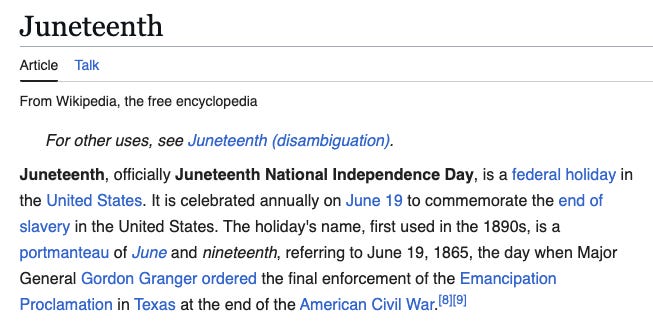
I want to celebrate Juneteenth and I suspect you do too. Emancipation is the closest thing America has to a redemption arc on its founding sin, and the end of slavery is an unambiguous good to be celebrated. We also don’t really have a good “major” holiday to celebrate Black Americans the way we do for, say, the Irish (St. Patrick’s Day) or the Mexicans (Cinco de Mayo).
I suspect the main reason for this is that wanting to celebrate Juneteenth either codes as Woke, or instead is treated as somehow a sacrilege against the fact that the holiday should reflect the failure of our country to fully live up to its promises of legal equality, or to tell its story in a way that treats its Black citizens with dignity. And if that is how you feel, I cannot argue with you—but then we simply will continue to ignore it, and Juneteenth will have no more cultural meaning here than Labor Day does.
On Notes, when I asked what I, as a White guy, should do to celebrate Juneteenth, a semi-large account told me to: “speak out against injustice.”
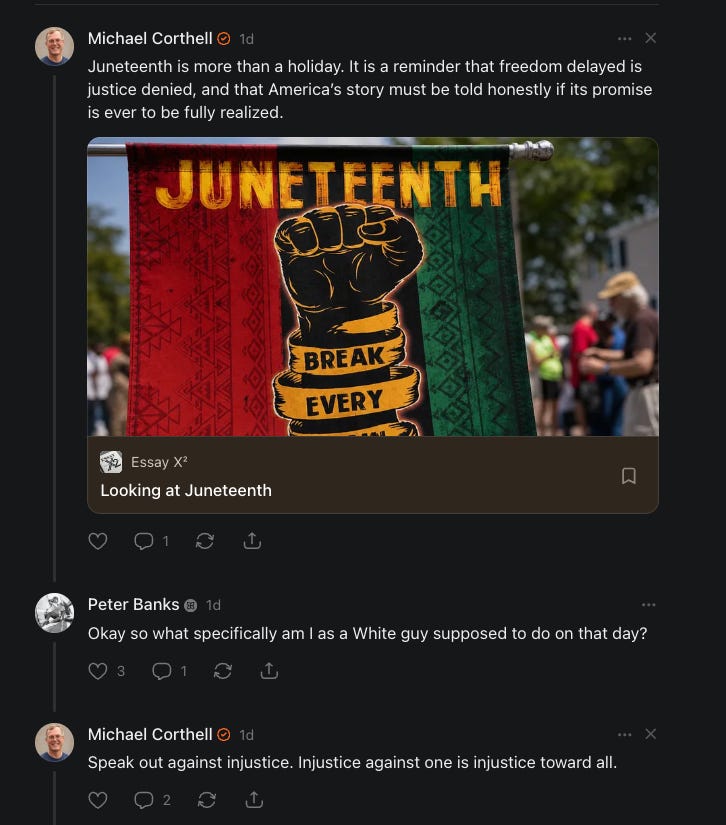
But what does that even mean? Am I supposed to post about racism today? Or call my family and talk to them about it? Because I’m not going to do that, and neither is the vast majority of America. And even if they were, that isn’t a holiday so much as a disposition. There is no collective ritual or celebration involved in this at all. Since we’ve handed people the options of either holding the racist past of America in their heart for twenty-four hours or ignoring the whole thing, today has become devoured by Father’s Day.
Ultimately, public holidays like this are the responsibility of government to run—not necessarily the federal government, although that would be ideal, but governments somewhere. Right now the cultural page is wide open. Nobody has decided what Juneteenth is in most of this country, which means we get to decide—and that’s not a burden, it’s an invitation.
For example, why doesn’t Virginia host something genuinely great next year? Big public barbecues in the parks. Celebrate the regular, hardworking Black Americans who built this place, and the folk heroes too—people like John Henry, born enslaved, freed after the war, the steel-driving man who beat the machine and died with his hammer in his hand. Talk about a real American. Do fireworks, or a parade, or just hot dogs and beer for almost nothing.
The content almost doesn’t matter at first, because what truly matters is the creation of a set of recognizably unique things you do on the day. Every good holiday, from Christmas to Thanksgiving, has this. It’s what lets everyone set down the tensions of daily life and celebrate a shared identity. Build that, and I’m convinced the masses would flock to it—the first real holiday of the American summer.
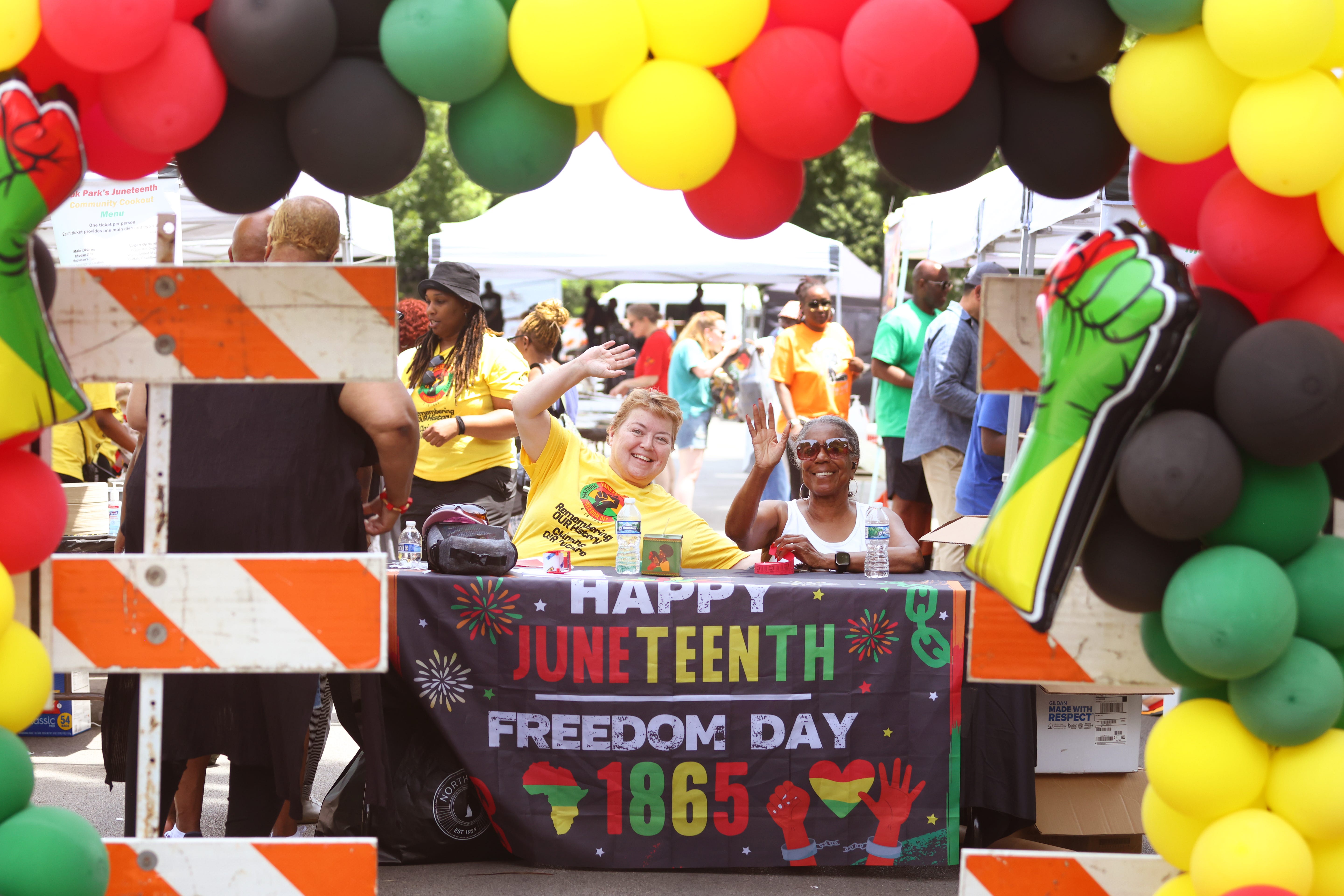
And it would be both at once: a genuinely fun day and a healing one. The end of slavery deserves better than to be mourned in silence or skipped entirely. It deserves a party. We just have to be willing to throw it.
I’m also looking to hit 100 paid subscribers(currently at 92), since I would very much like to get that orange check. So I’m going to attach a 90% discount here for everyone who wants to sign up. I’m going to be raising it substantially when I cross that threshold, so this is the cheapest it will ever be. Lock in an annual subscription for $5 now while you have the chance.