Form-Tested Welfare
and other Kafkaesque horrors
Summary: Peter Banks examines 'Form-Tested Welfare'—programs that gate benefits behind the applicant's ability to discover, understand, and navigate bureaucratic requirements rather than through means-testing. While such systems offer economic advantages by shifting compliance costs to applicants and can serve as a self-selection screen, Banks argues they systematically fail to reach those most in need, as people struggling with life logistics are least equipped to navigate paperwork and complex applications. The essay traces this paradox through personal examples (Tesla rebates, Stanford housing, gas bill waivers) and cautionary cases like Minnesota's EIDBI fraud, concluding that effective welfare requires either rigorous verification of signals or complete universalization to eliminate the need for forms.
About three years ago now, me and my wife purchased our Tesla Model 3 while living in California. Before this we had been using my Camry — Vivi — whose cries of pain whenever we used the brakes brought an uncomfortable amount of attention. I had always wanted a Tesla, and after test driving one I was frankly in love. I’m convinced that electric cars are like sushi in the sense that a certain class of Chud American has decided to hate them, but nearly everyone else who gets to try it falls in love. But this essay isn’t about the advantages, and disadvantages, of going electric. Instead it is about the subsidy that was attached to it.
Because what really clinched the decision for us was that we were eligible for up to $9,500 in cash back from the government if we bought it. This was split into a federal tax subsidy of $7,500 and a state cash rebate of $2,000.
It is the second one that I want to focus on right now, since the way it was structured was both weird and sorta annoying. Basically, after buying the car you had to go on this janky website and submit an online form claiming eligibility for the rebate, which California would then assess, and if you qualified — and if the program had not yet run out of money — send you a check. Yes, you read that right. The program was set up with a fixed pot of money in order to avoid it becoming some potentially enormous liability for the state, and when it hit the predetermined number, as it did on November 8, 2023, it would cease to give out rebates. California didn’t tell you about this rebate in any way, and the only reason I knew about it was because a friend of mine had already received it. Even the guy selling us the car only had the vaguest idea how it worked exactly.
I like to call this type of welfare “Form-Tested Welfare,” since it is, as the name suggests, gated not primarily behind income or qualification criteria, but rather behind you having some private information about the way the system works and a willingness to file and submit paperwork. Once you begin to treat this as its own distinct category of welfare, it is impossible not to see it everywhere.
Now my claim is this. I don’t think form-tested welfare is good or bad any more so than means-tested welfare. Ultimately it is a question of how well the screen works at identifying the “type” of person the program is aiming to target, and how efficiently it uses state resources towards addressing the real material problem. In the case of the Tesla it seems like a “fine” program. The goal here was probably to target people like me, and in that sense it worked wonderfully, and pushed me marginally over the threshold from buying a 2023 Toyota Camry to instead getting a 2023 Tesla Model 3.
But in other cases form-tested welfare is extremely poorly designed to reach its intended recipients, and in the worst scenarios becomes a den of lying which forces participants to realize the signalling game is broken and exploit it, or be a rube who is fucked over for trying to follow the rules.
Form-Tested Welfare
A month or so ago I missed a couple of gas payments. I thought I had set it to autopay, after manually running it for the first six or so months — these utility websites are the work of an eldritch horror — but I guess I messed something up. If they sent me emails, they must have been filtered into spam, because I still cannot find them, and I didn’t learn about it until I got a notice in the mail letting me know I had to pay now, or they would be shutting off my gas.
In addition to the missed months I also had to pay a $250 fine, or in their terminology, I had forfeited some security deposit and needed to replace it. What relates to this story is that on the document there was a small notification letting me know that I might be eligible to have this fee waived.
I have no idea if I qualify for this waiver. I’m definitely below the household median income in Loudoun County (~$182k), and a lot of these programs are anecdotally pretty generous if you just get on a phone and talk to someone. Ex ante I would guess I have a 15% chance of qualifying, and given it would only take me, maybe, 20 minutes to figure out, on paper I’m looking at an expected value in the neighborhood of $100 an hour. Let’s say, conservatively, it would be worth me doing, rather than sitting on my phone.
Still. I didn’t want to fucking fill out this form, and instead I just ate the bill. Hopefully autopay is sorted out now. My personal life is the one place I still feel definitely able to avoid expected value maximizing.
But I’ve been thinking about this waiver and how poorly it is designed to target the group it is clearly designed to aid. There are many plausible scenarios I can come up with where somebody doesn’t pay their gas bill, and we as a society probably want to intervene to make sure that person isn’t penalized. Take for example an elderly person who cannot afford it, or a young family behind on their bills. Even if you don’t sympathize with this group, clearly the gas company does, because they have set up the program!
The problem is fundamental: the kind of person who is good at conscientiously submitting forms is not the type of person who needs help, almost by construction. Let’s all be candid about the world here. If you are really good at keeping up with things, then you’re not someone who’s struggling with modernity. There is simply no one on skid row right now with the personality of a corporate compliance lawyer, walking around with their organized and color-coded paperwork. These two personalities are orthogonal to each other.
Everyone in my own life who I would want to be covered by a waiver like this — and I should be clear, I am not one of those people — wouldn’t even notice the letter before the gas was turned off.
Obviously academics have written on this — as they have on every possible idea you could have. For example, the Earned Income Tax Credit (EITC) is quite literally just cash that only requires you to file your basic tax forms. For many people it amounts to several hundred dollars a month, or a cheap car payment. And yet roughly a fifth of eligible taxpayers fail to claim it. A lot of right-of-center people may think to themselves “good, I’m glad the program is cheaper,” but if you first just accept that something like the EITC will exist, then, I think, this design is a huge problem. The families that are leaving money on the table are exactly the families the EITC is MEANT to help.
Perhaps the solution is just letting them know? And yes, there is some research on this as well. The IRS ran a field experiment on 35,050 California filers from tax year 2009 who had already received a government notice saying they were likely owed money — collectively $26 million — and hadn’t claimed it yet. The researchers randomized the follow-up mailing into a series of mailers of varying complexity, all the way down to simply displaying the dollar amount owed. Unsurprisingly, showing people the money increased claiming the most — by 8 percentage points — while the complex version of the notice cut claiming by 6 points, and a longer worksheet cut another 4.
You can take this as evidence that another part of the reason people don’t do stuff like file taxes is that it is just annoying, to most of us. Essentially everyone who enjoyed filling out paperwork — which, let’s be honest, is all that homework is — has had a wonderfully successful life.
There are many advantages to putting the compliance burden on the submittee, which I will get into next. But my emphasis here is that distributionally it hits, almost always, the core group of people aid programs are meant to help.
The optimizer shouts out in pain!
Form-tested welfare has broadly defensible economic ground to stand on, and was less the result of random drift than the product of conscious effort on the part of late 20th century reformers.
Because this system has a couple of natural advantages. Most importantly, it shifts the compliance onto the submittee. This means that it is your job to find the program and prove you qualify, totally removing that as a cost item from the state. Take for example my California Tesla rebate. Suppose California had wanted to instead process it for me. They would need to find out I purchased the car, figure out if I qualify, reach out to me and figure out the best way to pay me, and otherwise risk making a mistake at any point in that process. Additionally, that program had a limited pool of cash and ended up shutting down when it ran out of money, at which point the applications after the deadline got nothing, as I mentioned earlier. This means that if California had been the active party, they would have had to make explicit distributional choices — something the system they designed avoided thinking about.
Another advantage is that the hassle can act as a screen for need. Nichols and Zeckhauser (1982) show that if you impose an “ordeal” on applicants, you can improve targeting, because the people for whom the benefit matters most will endure the ordeal, while the scammers won’t. This is of course true ceteris paribus, but when are all things equal in reality? Tragically, we live in a world of partial equilibria. In fact, if you just add differences in the marginal ability to pay for the ordeal, you get a result more like what I’m proposing, where there are significant, negative effects on the quality of targeting. Kleven and Kopczuk (2011) formalize exactly this: model complexity as a by-product of screening, let people differ in their ability to navigate it, and the “optimal” program produces incomplete take-up and misclassification in both directions.
Distributional stuff aside, the much more serious problem I see with form-tested welfare is that it has a tendency of devolving into utterly fake, scammable systems which bring out the worst in all of us.
Confession time
Housing at Stanford is completely fucked. The campus basically acts as a mini city-state within Santa Clara County and is forced to negotiate a treaty of sorts where they pay tribute in exchange for being able to build vital public utilities. One of these utilities is housing, because the cost of renting off campus is prohibitive to almost everyone — Palo Alto is unsurprisingly expensive. But since they cannot just build however much housing they want, the school is forced to create a lottery system for assigning the scarce supply.
Everyone gets on a list which draws a number, and then they give people units based on some combination of their number and their preferred housing typology. I got very unlucky with my draw, and so me and my wife were sorted into a studio apartment. Naturally I immediately got in line — I was something like 750th — for a new apartment, and we moved into our new home. My wife and I, along with our cat, lived in a 400-odd-square-foot dorm room and just made it work. But it was annoying, because basically all of my friends had “normal” apartments with doors et al. On two occasions I went to housing and complained about the situation, just trying to see if there was anything we could do about it, and I was told definitively that the only possible way to switch housing was through the reassignment list. So every quarter I renewed it, and over the course of two years moved up to 500th in line.
One day I was complaining about this at lunch, and a friend asked me why I didn’t just tell housing that my studio was making me depressed, and they would get me a house. So I sent them an email saying the apartment was making me sad, true, and that it was making it harder to stay in school, also true. And lo and behold, literally within a month we had been reassigned into a beautiful two-bedroom townhouse which they had apparently summoned from the ether. What an absurd system!
This is how all of Stanford worked when I was there. Take our cat, for example. On paper, pets are totally against the rules on campus. There are essentially no exceptions, as housing says over and over again. Of course, you could be forgiven for not realizing there are any rules against campus pets if you just visited, since every green space is filled with dogs and many windows have cats looking down on you. The exception, as anyone who has recently been on a college campus will know, is of course the “emotional support animal” carve-out.
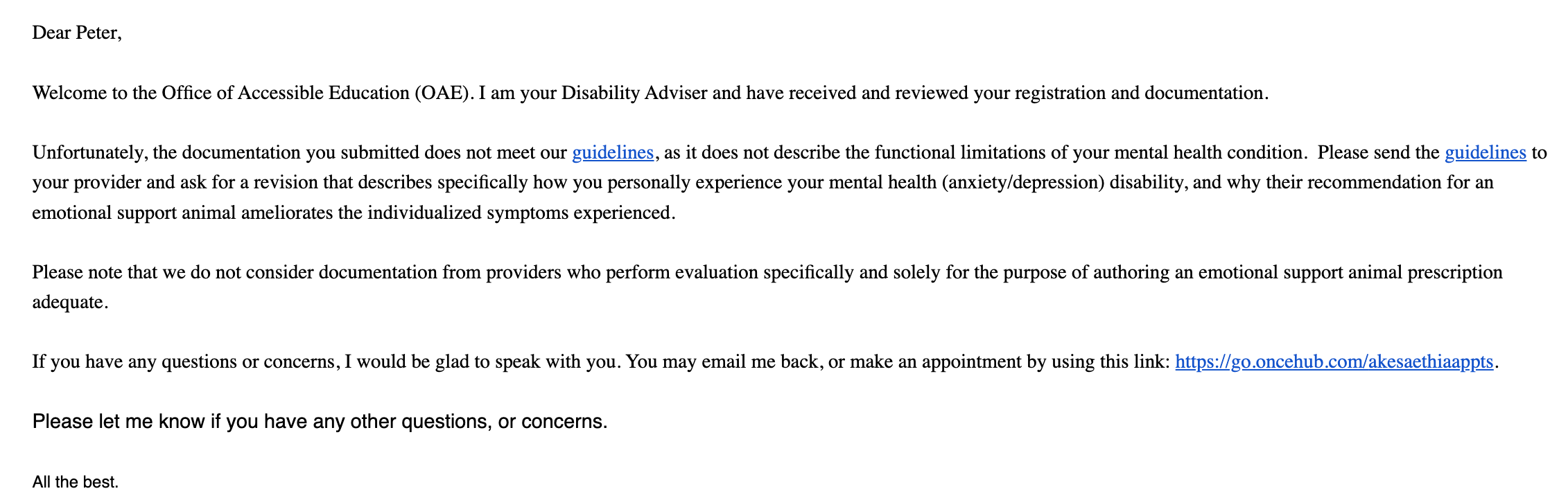
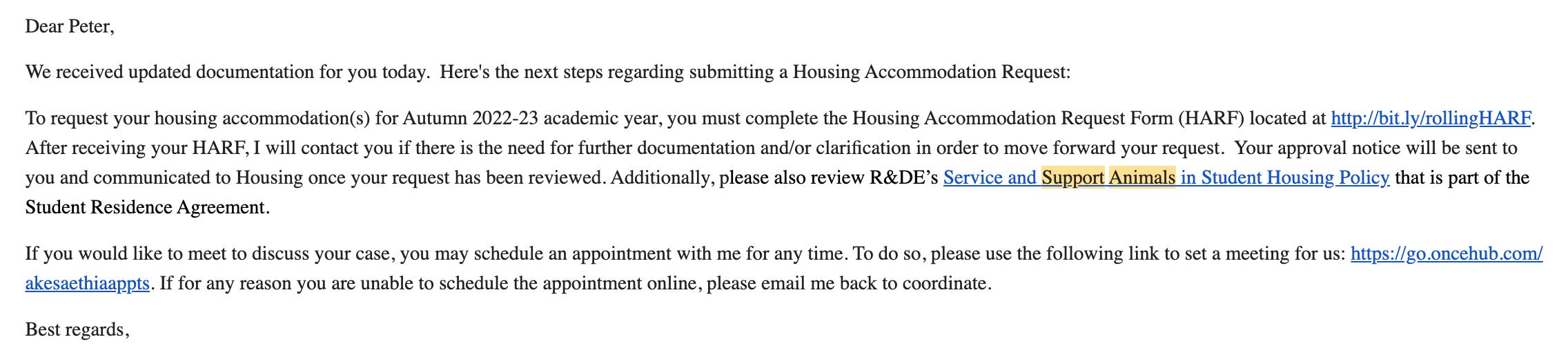
At some point colleges folded this category of pet into the broader definition of disabled resources, meaning that anyone who qualifies has a civil right to keep a pet in their room. We had a cat in Chicago, and so I got my therapist to write a note saying I needed it.
The school responded by telling me his note wasn’t sad enough, and that I should get him to submit another one better tailored to their specific criteria.
Once we knew the rules, it was easy!
When I say that this is how all of campus works, I mean it. My understanding is that undergraduate housing works roughly the same as graduate housing. One additional feature I didn’t mention, because it isn’t really a thing among grad students, is that disabled students are assigned housing first. On paper this is eminently reasonable: it would be insane to give a wheelchair-accessible unit to someone who doesn’t need it, at the expense of someone who does. But the way it has been actualized in recent years is absurd. The school itself advertises that 1 in 4 undergraduates are registered with its disability office — the same page notes that registering is “quick and easy,” takes less than an hour, and that you can start before you have any documentation. Reporting on the university’s own data put the registered share at 38% of undergraduates by late 2025, with 24% receiving academic or housing accommodations — up from about 5.6% in 2016–17. According to one campus analysis, more than a third of undergraduates now enter the housing draw with disability priority. I’ve heard numbers as high as one half before, but however you slice it, this is an absurd fraction.
I’m deeply skeptical that this represents some real change in the underlying facts, and I would even posit that a large fraction of these disability cases are completely fake. The problem, though, is that the overwhelming majority would pass an audit, even if the student is clearly not disabled in the sense Stanford means.
Take for example my cat. When they decided to let emotional support animals on campus, I don’t think they had in mind a case like mine, where I didn’t want to give up my pet. But I had a real, qualified therapist write me a note which, according to their own rules — which they pushed me to comply with — qualified me for that right. Where exactly did I break the rules? Nowhere. But what type of person does this incentivize me to be? The type of person who has to catastrophize my cat ownership as some deep pathological need, and who is assumed by everyone to rationally be doing this. What does Stanford possibly have to gain from fighting people who, by their own definitions, have special rights to keep a dog? Clearly little, because the campus is teeming with them and they cause no problems. But then, if they don’t “really” care about people keeping pets, the rules should reflect that. Incentivizing people to “lie” to function corrupts everyone involved.
Minnesota
I’m not sure if everyone has forgotten about Minnesota already, but it recently had a major welfare scamming fraud. The TLDR is that they ran a Medicaid benefit program called EIDBI — Early Intensive Developmental and Behavioral Intervention — for children with autism. Like all programs of this type, it was dependent on people submitting an application for coverage under some objectively designed criteria.
Between 2020 and 2024, the number of children receiving EIDBI services more than tripled — from about 1,400 to over 5,600 — and the program’s cost went from $38.1 million to $324.9 million a year. Not because Minnesota had experienced an eight-fold explosion of autism, but because the way the state was defining “autistic people” had nothing to do with reality anymore.
In September 2025, the DOJ charged the operator of a Twin Cities autism center who worked with professionals to get children qualified for diagnoses they didn’t have, billed Medicaid millions, and paid the parents monthly kickbacks of $300 to $1,500 per child for their cooperation — a $14 million scheme, to which she has since pleaded guilty. When the state’s legislative auditor reviewed how complaints had been handled, it found the Department of Human Services had spent years claiming it lacked authority to investigate kickback allegations — authority the auditor concluded it had held all along. The problem, as a legislative committee reviewing the wreckage stated, is that when agencies rely on attestation instead of documentation, fraud risk rises.
When you refuse to actually punish people who lie, form-tested welfare collapses very quickly, and can run roughshod for decades before it generates enough damage for people to take notice. There are countless programs like the Minnesota case going on RIGHT NOW, but the problem is they are too small to matter. The issue with this one is that they flew too close to the sun — if they had stolen only half as much money, no one would have been caught.
Verify or universalize
I’m not sure there’s a clever solution here, other than just, as always, an insistence on holding the government to task. There is no perfectly designed system without tradeoffs, only tools for men to manage the best we can. Still, I think you have basically two options when it comes to welfare. You can either:
Verify. If a program’s targeting depends on a signal, check the signal, and check who isn’t signalling.
Or universalize. Make the benefit automatic and waive the need for a form at all.