Crossing America
Reflections on a drive from coast to coast
Summary: Peter Banks documents a cross-country road trip from California to Virginia undertaken in June 2025 using a Tesla Model 3, reflecting on the cultural and geographic characteristics of different American regions. Throughout his observations of Nevada, Utah, Wyoming, the Midwest, and East Coast cities, Banks emphasizes stark contrasts in urban development, economic conditions, and regional culture, from Nevada's vice-driven economy to the Rust Belt decay of industrial cities. He concludes that despite America's numerous problems—urban decay, regional poverty, and suburban sprawl—there exists a binding cultural center to the nation that provides comfort through its fundamental familiarity.
Between June 16th and June 24th of this year (2025), my wife and I drove across the country—from Palo Alto to Northern Virginia. This is part of a big shakeup in my life I’ll talk about more in a (probably paywalled) essay soon™, but today I wanted to reflect a little on what I saw on that drive, because there is a clarity physically being in a place gives which no amount of Xitter or academic literature can mimic.

Car:
We did the drive in our Tesla Model 3, which meant that roughly every 120 miles we would stop for between 15–20 minutes to charge. I’ll be honest in anticipation, I was sincerely worried about this being extremely frustrating or even scary (what if we ran out of charge in the middle of nowhere?), but the reality was, as usual, mostly painless. In fact, I found stopping roughly every two hours to be a big improvement over the previous time I drove across this country, where often I wouldn’t stop for hundreds of miles.
Instead of staying in the car until we were about to burst or our backs were killing us, we would instead stop and get coffee or go for a quick walk often enough that the trip actually, experientially, went by much faster. I also just love driving a Tesla. If you haven’t had the chance to try one, I highly recommend it. Our previous car was a 2014(?) Toyota Camry we affectionately nicknamed Vivy, and she had almost died on the drive—especially trying to climb the Rockies—but Tessie (our extremely original name for the Tesla) handled them with great aplomb. Additionally, Teslas are in general very comfortable cars, other than having suboptimal noise insulation, and this made an enormous difference.
Two final thoughts on the car. First, in theory, the battery has a range closer to 250 miles than 120 miles if you were willing to go from 100% all the way down to 0. However, we found that staying between 20 and 80% gave us the most confidence we wouldn’t be stranded on the road and also meant we avoided charging the final 20%, which often took longer than the first 80%—batteries are weird. A couple of times, for example in Wyoming when the chargers were spread out more thinly or if we stopped for lunch, we would charge to the full 100%, but this was relatively rare. One thing that was a source of some real frustration was that the estimated battery life always overestimated the charge we would have at our final location, and Tesla—probably in an effort to save us time—would add chargers to the map but have us arriving with under 10% remaining. This was almost certainly a result of the heatwave going on (we were blasting AC) and the fact that our car was unusually heavy (it was full of suitcases), but an explanation does not make it less annoying to have to manually look up the chargers and add them.
Second, there is an enormous potential to make electric charging stops very cool, and I’m excited to see what they are like in 30 or 40 years. Right now, because the demand isn’t that high outside of Blue cities, they are mostly tucked into random corners of hotel parking lots, and we would have to trudge through Midwestern suburban sprawl (hell) in the heat to get lunch.
The Drive
Trigger Warning: I might not like your hometown.
Day 1:

On the morning of June 16th, we left Stanford campus and hit the road headed east. My wife and I had put off the last touches of our packing—most of our junk had been put in a pod and shipped out the day before—which meant we stayed up until 2 a.m. that night getting everything in order (silly 20-something nonsense). This meant that when we hit the road in the morning—our keys had to be returned before 8 a.m.—I was in the high-adrenaline, high-caffeine, low-sleep state that exists on the border between pleasure and panic. Our first stop was Sacramento, California, and we charged in the basement of the “Golden 1 Center,” where we ate very mediocre Mexican food1. My main impression of Sacramento was that it was clean. The cleanest city I’ve seen so far in California. This cleanliness came with an eerie sense of emptiness, though, and the entire city seemed borderline abandoned—perhaps it was our location or the time of day (Monday morning). Whatever the cause of the empty streets, the city vaguely reminded me of those Chinese mega complexes you will see video essays about, where huge skyscrapers line silent streets.

From Sacramento, we continued west on I-80 (which we rode until Chicago) through to the city of Reno. I know I’ve offended a couple of people on Substack with my reflections on Nevada, but I’ll be honest—I hated Reno. We stopped to charge near the Silver Legacy Resort Casino and took a fitful nap in the beating sun. Seriously, why is the sun so much worse in Nevada? On our drive out of town, we saw a collection of characters wandering the streets in the noonday heat, including one White man with a belly that seemed ripe for a Xenomorph to explode forth—but which was almost certainly the result of a crippling alcohol addiction. Who knows, perhaps he was abusing HGH.

Nevada strikes me as an odd state which has grown fat mostly from governmental dysfunction in nearby California. So, as California bleeds treasure and Men, they seep into the Great Basin in order to escape “Blue communism”. However, California, for all of its faults, is one of the most geographically beautiful locations on Earth, which makes the contrast with its neighbor all the more painful. Because if the Golden State was just run with even a moderate degree of competency, no one would have to live in the desert—although I’m sure some crazed madmen still would.
Since the whole state seems to exist to provide services California refuses to provide—including housing—it also attracts a degree of vice I personally find off-putting. Every town we stopped in had a casino of some kind, and many of the people I saw seemed to be dried-out husks rather than fully formed Humans. God did not intend man to live in this wasteland, and a part of me genuinely respects the individuals who have managed to maintain the outposts of civilization required to allow people like me to safely cross this country. That night we stayed at a Best Western in the tiny city of Elko (pop. ~20k). The hotel was quite nice, given our budget, and it won us to the Best Western brand for most of the remainder of our drive.
Day 2:

For our second day, we hit the road with the intention of stopping in Laramie, Wyoming (pop. ~31k). This meant we had to drive through the remainder of Nevada, the top of Utah, and then about three-quarters of Wyoming. Nevada continued to disappoint, and I have little more to add beyond what I’ve already said. We crossed into Utah near the salt flats and then emerged in Salt Lake City (SLC), where we stopped to charge and got lunch at House of Subs (it was fine).
Three things jumped out to me about Utah:
First, my family mostly lives in the suburbs of SLC, so I never went into the city much when we would go out to visit as kids, and I’ll be honest—I was not impressed. Every American town which had most of its development occur after WWII is a godless stretch of strip malls, often literally stretching out of sight into the horizon, and SLC was probably the worst version of this we experienced, at least near the highway.
Second, everyone in Utah seemed to be both physically and spiritually healthier than the people in Nevada. I don’t have, or care to search for, the data to support this claim, but I suspect you all know vaguely what I’m pointing at. If you have ever visited a European country, one of the first things that jumps out is how much healthier Euros look than Americans. Everyone here looks vaguely inflamed and fat, and the contrast between Utah and Nevada was similar. The state mostly lacked the strung-out population that seems to be drawn to the West by the allure of the dole and a lax drug policy, but I also suspect Mormonism plays a substantial role in this.
Third, there was a Utah I remember from my childhood that is slowly dying. I never lived in Utah growing up (other than a stint in AmeriCorps before college in Hurricane, just outside of St. George), but it has been sad to see the Mormon ethnostate that existed in my childhood slowly be pulled into the maelstrom of American Plebeian culture. SLC in particular was full of coffee shops and bars—in other words, full of haram activity and Gentiles. I’ve left the Church and am drinking a coffee as I write this, so it is hard for me to be overly critical of other people making the same choices I have or of the people who are drawn to the surplus created by the homogeneity and religiosity of Utah. However, in many ways, the Church I knew up close seems destined to die—and with it the last gasp of Anglo culture in this country.
Lo, all our pomp of yesterday
Is one with Nineveh and Tyre!
Recessional by Rudyard Kipling 1897
From Utah, we crossed into Wyoming following I-80 and drove through easily my least favorite state in this country. If Nevada earns some begrudging respect from me for its obstinate resistance to nature and its acceptance of vice as a source of revenue, Wyoming is legitimately a bad state. I’ve been to northwestern Wyoming only once, and at the time I was much more interested in the girl I was dating and the throes of that relationship than I was in the beautiful geography, so nothing I’ll say has anything to do with Yellowstone or the Tetons. But I’ve driven through the state twice now: first when coming out to California, and then second on my return east. Both times, I’ve been struck by how empty it is. Wyoming is huge, slightly larger than the United Kingdom, but it has a tiny population, about the size of Malta and this means there are truly enormous empty spaces. This time, we hugged the bottom of the state, and it was mostly ~fine~, much better than three years ago when we drove diagonally across it and were exposed to a literal ocean of yellow grass.
It wasn’t all bad, of course. As we headed east, the state became more and more a part of the midwest, which is a culture I have an enormous amount of respect for. Near the Utah border, what civilization exists is decidedly intermountain, but by the time we reached Laramie (which is in the outskirts of Cheyenne), things gradually became more Germanic in their cultural affectation. Laramie itself was in the heritage of all caravan towns, and I have little to say about it.
Day 3:

The original plan had been to stop in Omaha, but my wife wanted to try and visit a restaurant in Chicago that is important to us, and that would have been impossible to do before it closed in a single day, so we pushed through until Des Moines. Humorously, we didn’t end up going to the restaurant—life is funny—however, it meant I got to experience the entire state of Nebraska in a single go. If Nevada was a wasteland and Wyoming was an empty void, Nebraska at least seemed like a place Humans could live in, even if it lacked any clear signs of natural beauty. The state did become prettier as we worked our way east and the average annual rainfall crept up. It is funny because even sitting here now, only a few days after the drive, I’m struggling to think of even a single fact about the state other than the rolling fields which clung to the horizon.
There was one funny fact I’ll write a full article about in the future, but Trump accidentally legalized weed in 2018 as part of his farm bill, which means in any state you can go buy weed right now. Seriously, I’m not joking. Since that bill decriminalized hemp and people realized that Delta-8 THC is experientially identical to Delta-9 THC but was now legal, you could sell weed anywhere in the country, including via mail. In most states, this is kept moderately on the hush-hush and confined to smoke shops run by Arab men, but in Nebraska it was proudly advertised on billboards. I found it legitimately funny to drive past a huge sign advertising a dispensary in a state where weed is still illegal recreationally.
After crossing through Nebraska, we entered Iowa, and I’ve got to say I was very pleasantly surprised. The state is extremely beautiful, with these gorgeous rolling verdant hills of corn. I’m not sure where I had formed a negative impression of the state, but I had, and so I was pleasantly surprised. HyVee (a grocery store) was particularly impressive to me, although the Chinese food I got at 9:30 p.m. there was mid at best. Des Moines itself was like all Western cities—a collection of suburbs brought together by a financial district—but it was at least clean. We didn’t stay in a Best Western this time, which broke my loyal heart.
Day 4:
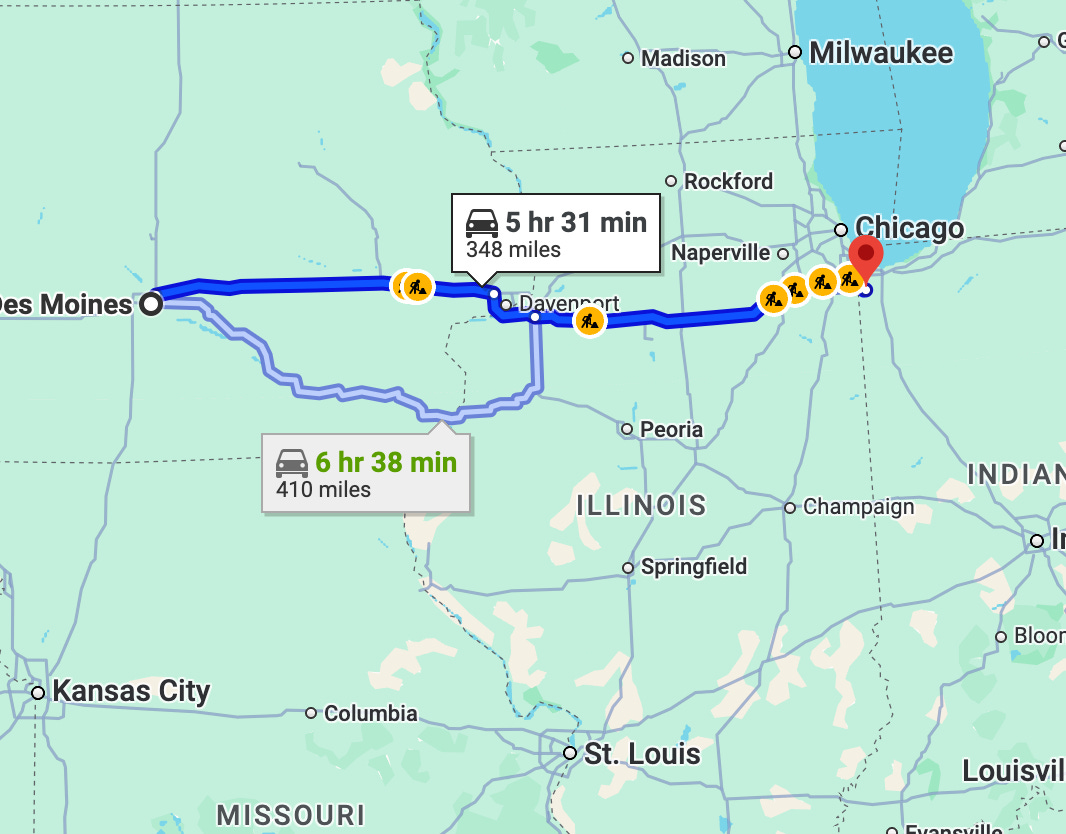
This day was a shorter one. The original goal had been to make it to Chicago early enough to go to the restaurant I mentioned earlier, but we ended up hitting a ton of traffic in the suburbs and decided to redirect to our hotel. Illinois is a state I have a lot of experience with—I lived in Chicago for two years while working at the Booth (2020–2022)—and my experience there was transformatively negative. Of all of the cities I’ve had the pleasure to live in, there is no city I despise more than Chicago. In fact, an enormous amount of my worldview was formed by my time on the South Side, where I was rigorously and totally disabused of almost all of my liberal sentiments.
This time, we stayed just outside of the city in a place called Schererville, Indiana, where we were for a couple of days for a very close friend’s wedding in the area. The contrast between Chicago Heights (median household income of $57,479 and median home price of $149,900) and Schererville (median household income of $86,020 and median home price of $294,600) was, like all of Chicago, far more stark than mere numbers can describe. What always stands out to me about the South Side, which was true for Chicago Heights, was the degree of trash everywhere. While driving, I saw multiple people throw stuff out of their windows onto the side of the road. I’ll stop my editorializing here, other than to say I have no intention of ever returning to that city, and they will continue to get the services they vote for.
Day 5, 6, and 7
We were with friends for their wedding. It was really fun, and Indiana is a nice state.
Day 8
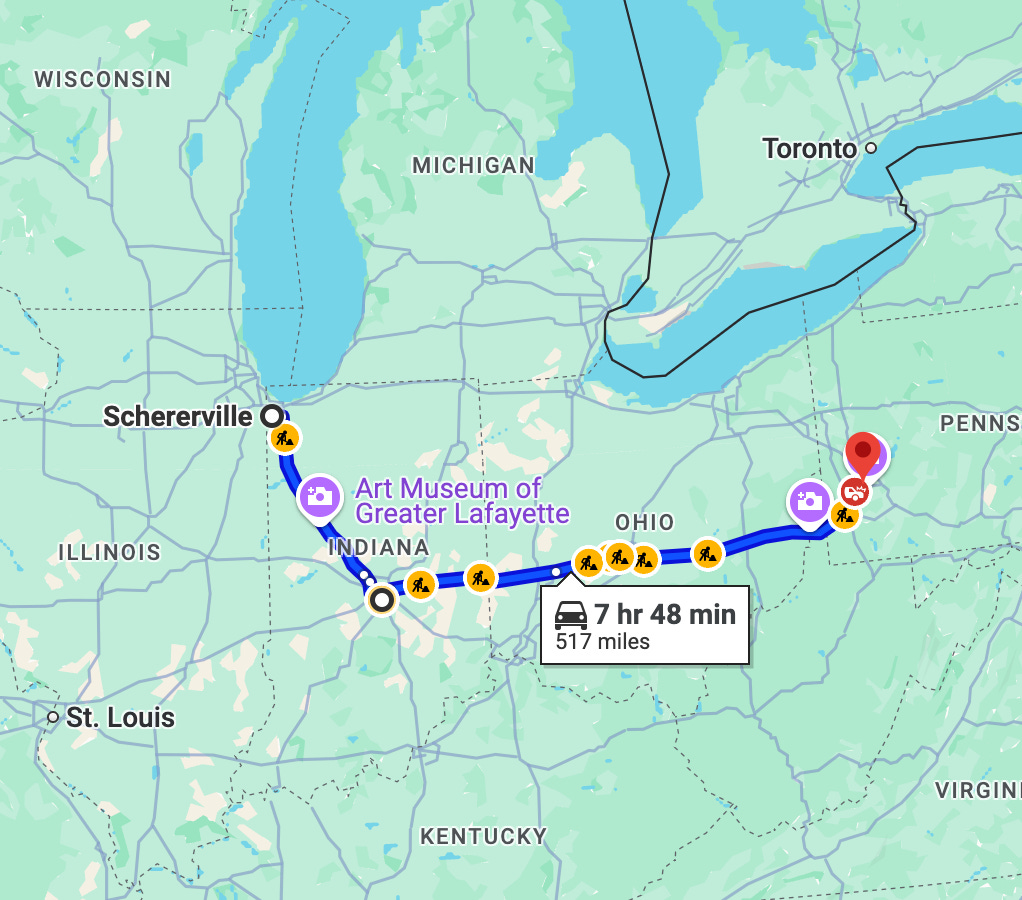
From the wedding, which was in rural Indiana, we cut south into Indianapolis and then east across the state into Ohio, through Columbus, and on into Pittsburgh. Indianapolis seemed like a dump and was the first “real” Rust Belt town we saw. If West Coast cities are defined by homeless drug addicts and beautiful scenery, and Midwestern “cities” are long stretches of soulless fast food restaurants, East Coast cities are even more tragic. I first noticed this as a kid living in the DC suburbs, then saw it again in Chicago, and now cannot unsee it in every city I go to. Some of the most beautiful buildings in this country lay rotting out in a quasi–war zone that is the American inner city. Indianapolis, or at least what we drove past, was like this.
From there, we crossed through Ohio, and as we went east the cultural geography changed from Midwestern to Appalachian—in other words, it deteriorated. My impression of rural Ohio was not positive since it mostly reminded me of West Virginia. Geographically, it was quite beautiful, and the rolling hills of green were frankly stunning. We stopped in one town in particular, whose name eludes me, and I was struck by the scale of white rural poverty—a phenomenon which was mostly absent from our drive thus far.
![Poverty in the United States[1100x850] : r/MapPorn](https://substackcdn.com/image/fetch/$s_!lu6N!,f_auto,q_auto:good,fl_progressive:steep/https%3A%2F%2Fsubstack-post-media.s3.amazonaws.com%2Fpublic%2Fimages%2F86fd8de1-22de-4708-b734-acfea0f91b9d_2048x1583.jpeg)
We arrived in Pittsburgh in the dead of night, and the highway interchange outside of the city was the most diabolical thing I’ve ever interacted with in my short life. Truly, it was created by an urban planner who wanted to create the maximum amount of confusion and suffering and who succeeded with incredible skill. Everywhere was closed, so we UberEatsed some pizza and—wow. I fucking love East Coast pizza. Seriously, it was incredible.
Day 9:

On our way to California, we had stopped at a Thai restaurant, and it had blown us away, so we decided to have a late start heading to NOVA—it wasn’t that far of a drive—and so we spent the morning wandering the streets of the city until the place opened. Now, I’m not sure what it is about Pittsburgh, but it seems to have attracted a unique, from my experience, blend of White and Black poverty into an inner city that is stunningly beautiful. Perhaps it was the fact we were walking around on a Tuesday morning during a heatwave, but I saw a truly diverse assortment of poverty and dysfunction2. In addition, there may have been a protest or something, but some lady was handing out water bottles, and while walking by I was looking at the massing of white, fighting-age men dressed up in what seemed like combat gear. My initial thought was that perhaps they were doing some weird play, but the lady told us that it was best to not look and keep walking, and I didn’t argue with her.
But even with the above, the city was still spectacular. I found the PPG building to be absolutely stunning, and it felt like all East Coast cities—or home.
After lunch, which was quite good, we hit the road and made it safely to our final destination. Rural Pennsylvania has a lot of the same problems as rural Ohio, but they seemed to dissipate as we crossed into Maryland, and by the time we crossed the Potomac into the Piedmont region of Virginia, the countryside had turned prosperous and bucolic again.
Final Thoughts:
I’ll leave you with these parting words. America is an enormous country full of a huge amount of cultural diversity. It is, like all countries, a work in progress without a clear destination or purpose, but it also is clearly a nation like any other. There is a binding center to this land that, for all of its faults—blown-out inner cities, Appalachian poverty, horrible strip malls—is fundamentally comforting in its familiarity. I love this land and these people.
Please consider becoming a paid subscriber. For $5/month or $30/year, you'll gain access to all my paywalled articles and earn a permanent spot in my heart.
I’m not sure if this is controversial, but I found California Mexican food to be extremely mid, the worst of any state I’ve lived in—what can I say, I’m White
Pittsburgh would make a progressive happy!