Ai, Authenticity, and "Peter"
On the uses and abuses of AI
Summary: Peter Banks examines his philosophy on using AI as a writing tool while preserving authenticity and human creativity. He argues that while AI excels at practical tasks like editing and research, it risks obscuring meaningful ideas with polished mediocrity and false eloquence. Banks contends that his competitive advantage as a writer lies in his authentic human voice and genuine perspective, which AI cannot replicate. He commits to using AI judiciously for specific, bounded tasks while refusing to let it replace the core intellectual and emotional work of writing.
I wanted to today discourse a little on the uses and abuses of AI. Because the truth is that I’m rapidly becoming unable to confidently identify if something is a genuine product of Human creativity or if Chatty has spun it up. Given whatever small barrier still separates me from the throes of perfect competition as a writer are rapidly disappearing, now is the perfect time to reflect on the future of writing and outline how I intend to use AI. This second part is particularly important, in my opinion, because AI is already proving enormously useful to me from an editing and idea ideation perspective, but it is incredibly easy to slip too far.
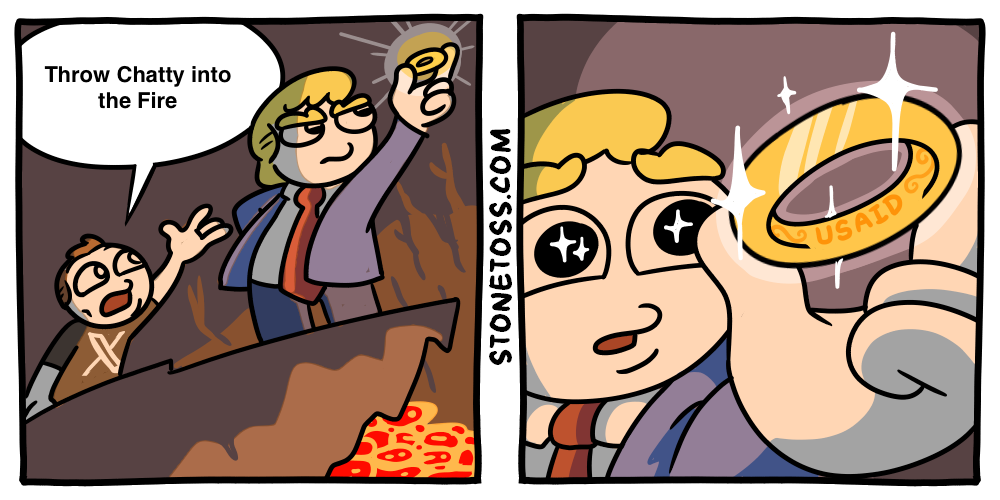
To understand how I feel about AI, it is worth first articulating what I see the purpose of writing to actually be. I believe that it is my obligation—and my joy—as a writer to try and communicate my internal mental state as clearly as possible. The limitations of the medium mean that this is impossible to do perfectly, but the best writing is still the clearest writing. Sometimes, when you are communicating the confusion of existence—such as in a work like Infinite Jest—obscurity is acceptable. But few of us are David Foster Wallace (I know I am not), and so clarity should always be the purpose.
Given the above, I feel like anything that helps me communicate my perspective is a boon and something I intend to use. However, where AI becomes dangerous is when it occludes the weakness of an idea by giving it false eloquence or hallucinated evidence. I’ll find myself sifting through 2,000-word essays on Substack, trying to find the maybe 50-word idea that was originally used in the prompt. Sometimes the post-Chatty world feels like this meme I generated:
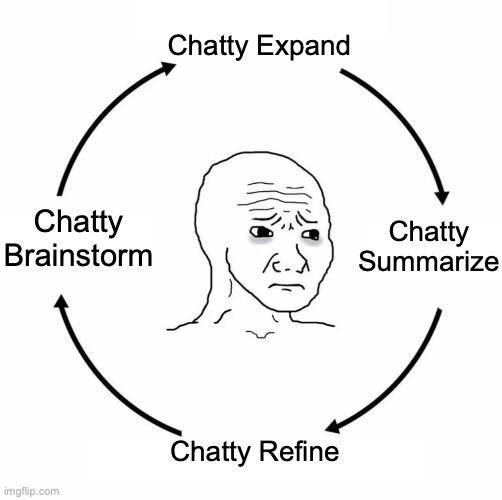
Or put another way, I’m reminded of the Bilbo quote from The Fellowship of the Ring:
[Ai feels] thin, sort of stretched, like butter scraped over too much bread.
In other words, AI is a tool that makes my life easier, but it can create negative externalities on you, the reader, by wasting your time. It would be trivial to, for example, turn this entire publication into an automatic slop feed—particularly if I were willing to stake out a moderately controversial political position. But I think that, in the long run, this would be counterproductive. Because it is my deeply felt—but yet unconfirmed—suspicion that the most important thing for me to cultivate is authenticity. As AI becomes better and better, my only comparative advantage will be my Humanity.
I personally consume art—of which Substack articles are a form—because I want to relate to the person behind it, not because I’m interested in the opinion of the modal Redditor condensed through fine-tuning to avoid anything even moderately edgy or controversial, but draped in the purple of literary language. In fact, it’s been interesting to notice how much better I’ve become at identifying the products of AI even as the models improve. Why? Because they are mostly devoid of anything interesting or novel to say.
Seriously, try to get Chatty to spin up an article about something you know to be true but that you would feel uncomfortable saying in front of your HR manager. It will not only fail to understand the point, but it will write the most hackneyed article you can imagine. The truth is that these models are designed to mimic the distribution of text that they are trained on, and a disproportionate amount of it comes from a very odd moment in the cultural history of the Anglo world—1990–2020.
So if your dream is to write BuzzFeed articles about how James Corden is racist, AI is ideal. But if you have any intention of pushing the envelope, it is important to understand its limits—at least as it currently stands.
However, I still use AI daily. Specifically, I’ve found that it is incredible at a couple of tasks.
First, and most importantly: editing. I’ve talked about this some on Substack already, but I’m pretty severely dyslexic, as anyone who follows me on Notes has doubtless observed, and so writing has always been genuinely difficult—and borderline magical—to me. My actual sentence structure is mostly fine, but my spelling and use of punctuation is closer to a 4th grader than a 27-year-old. Early in my writing online, this meant that I had to spend an enormous amount of time going over everything I wrote with a fine-tooth comb and ask people like my dad or friends to do a final pass. Now, with Chatty, that is no longer true, and I can write like a 19th-century aristocrat.
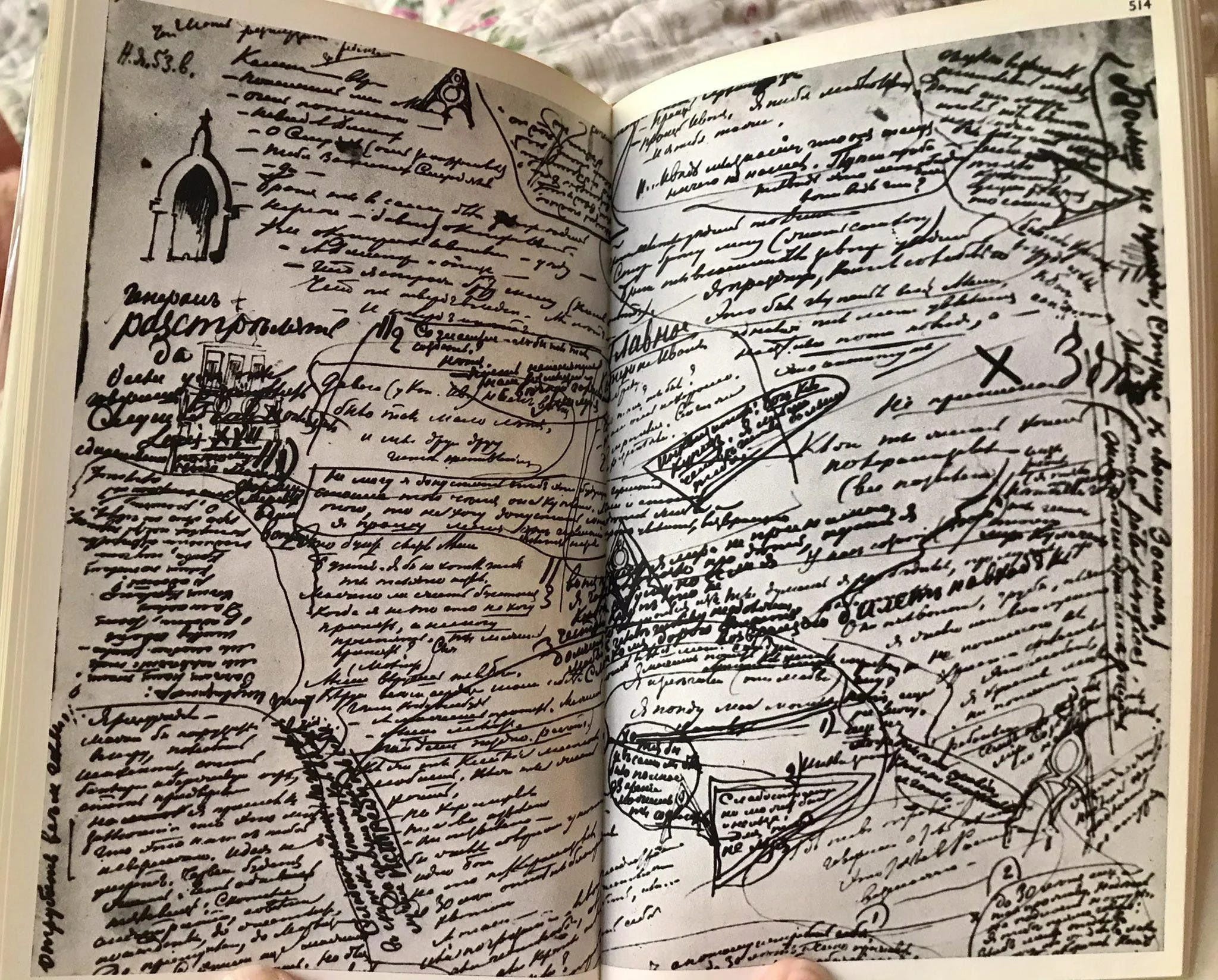
I will continue to do this probably forever, and I fully expect to pass everything I write through an LLM to fix basic errors. I’ve found Chatty to be uniquely good at this because grammatical and spelling changes aren’t in the tails of the distribution and aren’t controversial in any serious way—although I’ve found it will often, frustratingly, remove some of my more spicy word choice.
Second, I use AI to summarize text. Like all people, the amount I would like to read vastly outstrips both my time and my interest in reading. Thus, I’ve found that the ability of Chatty to take large volumes of text and summarize them to be invaluable. If you give the model a text directly, it experiences fewer—but not zero—hallucinations and generally does a solid job presenting the information.
Third, I use AI as a tool for idea generation, source procurement, and basically a super-powered search engine. This is undeniably the most dangerous way that I use these models and the one I need to think most seriously about. But the truth is, if I have a question like: “When do Democrats use the term Western?” it’s unlikely that there will be very much out there already, and I’ve found that Chatty’s deep research function is quite solid at figuring out these kinds of questions for me. The risk here is, of course, that it will invent or misrepresent the truth—but Humans do this also, frankly probably more—and it is a risk I am mostly willing to accept. I usually try to double-check the results it gives me, but often this can prove difficult since I’ve turned to AI because of a lack of Human-generated answers.
In short: AI is awesome, and I use it to make my life easier. The intention is always to improve both my ability to seek the truth and to communicate it to you, the audience. If this changes, I will be sure to let you know. Because again my goal is to express myself not simply mimic the crowd.